Tuesday, July 7, 2009


Hey do you ever look at books?

I'm pretty sure I can assume with some degree of accuracy that if you're reading this blog you have an interest in literature, read novels, poetry, history, etc. Aside from reading though, do you ever take a good long look at the book you're actually holding in your hand? What's on the cover? How is it bound? Is it embossed? Is its viewing pleasure increased with the addition 3D glasses? What?

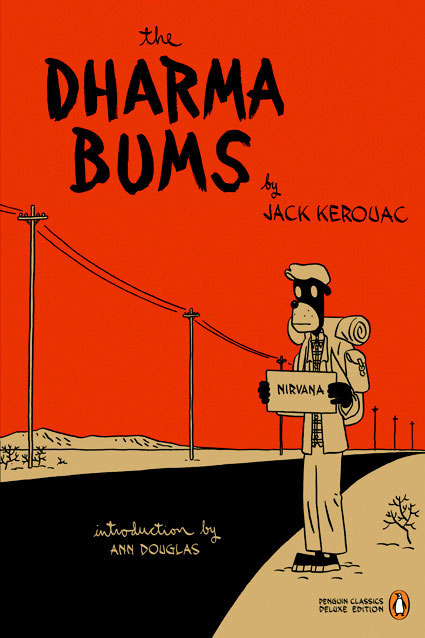
Five days a week I pass truckloads of books through my hands at Green Apple, and as I move them about I can't help but be taken from time to time with some of the creative, occasionally downright strange things printed on them. Now I could prattle on for ages about what strikes me as an effective cover, but that topic can be stretched so broad it could probably fill a book itself. So to the point I'll write a bit on a trend that excites me very much right now, publishers who are calling on underground comic artists to do cover designs. It seems like such a no-brainer to me, but if you know much about the comic artist's long struggle for recognition in the American literary/art world then it really does become clear as to why we're only just now seeing this.

Since we're long past the "ten cent plague" years of the comic world, and even a little beyond Dan Clowes' (brilliant in my opinion) 1997 Modern Cartoonist essay, great publishers like Penguin and Random House have been calling upon many of the giants of the underground. Above is Sammy Harkham's design for the most recent reprint of Kafka's stories. Now what's great about knowing who the cover artist of this particular edition is, is finding that Harkham also edits the critically acclaimed Kramer's Ergot compilations, which features works by several little known (and some a lot known) comic artists (and yes we are carrying it).

I suppose my point is this: You may not be able to judge a book by it's cover, but if you choose to, if something is particularly striking about it, I implore that you track down it's origin. One great piece of literature can lead to another and the clues may not merely lie in the words themselves.

On the fly I've come up with a short list of book covers which I can readily supply you with the name and career of the brilliant artist(s) behind them.


Cover design by Peter Bagge.


Cover design by Charles Burns.

Cover Design by Jason.

Cover design by Dan Clowes.
(extra points if you can tell me the pseudonym Daniel Handler uses for his young adult series)

And lastly here's a little gem by Chris Ware for the upcoming edition of Voltaire's Candide. I just can't do this one justice by shrinking it down for the blog.

Of course comic artists aren't the only ones out there coming up with great designs, and if you don't like comic art I'm cool with that (sort of). Check out the New York Times Book Design Review if you're looking for a aesthetic that suits you better.

Sunday, July 5, 2009

GBL - Drinkin'

A few months ago, I introduced to the virtual world one of the more cramped displays in our store, the twelve shelves on the landing of our main stairs we call the GBL. (That post, about our Literary Feuds display, can be found here.) (Don't think too hard about what GBL means. It's not something we can divulge to the general public.)

Before I blacked out from yesterday's holiday drinking, I got thinking, in an admittedly muddled sort of way, about another of our GBL shelves, which for lack of imagination we call simply the Drinkin' display.

Writers have long been known to drown their angst in the bottle. And some writers have a lot of angst. Our national literature is full of plastered heroes: Jack London wrote a book called John Barleycorn which documented his lifelong problem with hooch; Hemingway, apparently, could go head-to-head with the more prolific of his characters, one of whom downed three martinis and a few bottles of wine before lunch; and then of course there's Edgar Allen Poe, John Cheever, Sinclair Lewis, Eugene O'Neill, John Steinbeck, Jack Kerouac, Dorothy Parker, Hunter S. Thompson... Well, you get the point.

So, in celebration of (er...) the besotted, we've lined up seven books written by or featuring (or both) stumbling drunks:

Appointment in Samarra: John O'Hara's classic novel of Julian English's swift and terrible decline, featuring the infamous scene in which English throws his drink in another man's face.

Frederick Exley's savage indictment of the 1950s and one of Pete's favorites, A Fan's Notes.

In the Long Goodbye, Raymond Chandler wrote: "Alcohol is like love. The first kiss is magic, the second is intimate, the third is routine. After that you take the girl's clothes off."

My personal demon isn't booze, but it's a book about booze: Under the Volcano.

No list like this would be complete without the work of Charles Bukowski (pictured above) who once wrote that "Drinking is an emotional thing." We chose Factotum as a fair representative of his alcoholic genius.

Naturally, we can't ignore my people, the Irish:

Of Flann O'Brien's novel, At-Swim-Two-Birds, Dylan Thomas said: "This is just the book to give your sister – if she's a loud, dirty, boozy girl."

Finally, there's A Drink With Shane MacGowan. The collage below (via J-Walk Blog) says it all:

Saturday, July 4, 2009

FOUND: Adorable note

As stated in previous posts, we find a lot of great stuff in the books we buy back from the community. Though they range from frightening to downright hilarious, this is definitely the cutest, sweetest thing I've ever seen:

Friday, July 3, 2009

Store Motto

I've been pondering lately if we should have a Green Apple store motto. New York's Gotham Book Mart's famous store motto was "Wise Men Fish Here." Shakespeare & Co. in Paris has "Be kind to strangers , lest they're angels in disguise" above one of their doors, so that may be that store's motto. If Green Apple had a store motto, it would have to be something reflective of the store, of course. Something generic like "Bringing books and the people who love them together" isn't really going to work.

There used to be a beloved bar in the neighborhood, Pat O'Shea's Mad Hatter. They've been closed a few years now. The motto above their door was "We cheat tourists and drunks." Might scare some people off, but I think most folks understood it to mean they were entering an establishment with some character, one that wasn't afraid to have some personality.

One candidate for Green Apple store motto that I like was uttered unwittingly by one of our buyers in the act of being haggled with by a customer hoping to get more for the books they were selling: "We're not here to break even," he said.

But my candidate for store motto is "You can't step into the same Apple twice" (a nod to Heraclitus- Panta rei, ouden menei -- all things flow, nothing abides). Green Apple brings in literally hundreds, some days no doubt thousands, of books over the used book buy counter every day. One day we might buy someone's collection of crocheting books, and in one swoop go from not having much of a crochet section to having the best in California. Then those books will sell and over time we'll go back to having a crochet section like any other store.

Outside events also change the store. The 9/11 attacks and the War on Terror (or whatever it is being called) pumped our Middle Eastern history section from a handful of books to a full bookcase. The election of 2004 saw so many anti-Bush books published, they made their own section. The day after Bush beat John Kerry, they all got sent back. It wasn't funny anymore.

So for now, until I hear any better suggestions, the official Green Apple store motto is "You can't step into the same Apple twice." I'd love to hear some other ideas.

Thursday, July 2, 2009

New Dave Eggers!

Dave Eggers is always one of our best-selling authors, and each book is generally very different from the previous ones, so it's always interesting to see what catches his interest and what he does with it. The latest, Zeitoun, arrived today.

When Hurricane Katrina struck New Orleans, Abdulrahman Zeitoun, a prosperous Syrian-American and father of four, chose to stay through the storm to protect his house and contracting business. In the days after the storm, he traveled the flooded streets in a secondhand canoe, passing on supplies and helping those he could. A week later, Zeitoun abruptly disappeared. Turns out he’d been detained as a suspected terrorist, kept for 3 days in an open cage, then sent to a prison for two weeks without being charged.

In Eggers’ own words, this is a book about “the intersection of so many issues in recent American life: the debacle of the government response to Katrina, the struggles facing even the most successful immigrants, a judicial system in need of repair, the problem of wrongful conviction, the paranoia wrought by the War on Terror, widespread Islamophobia . . .”

Eggers explores Zeitoun’s roots in Syria, his marriage to an American who converted to Islam, and the surreal atmosphere (in New Orleans and the United States generally) in which what happened to Abdulrahman Zeitoun was possible.

Wednesday, July 1, 2009

Rise and Shine


This morning I drug my weary bones out of bed at 6:15, navigated through the downtown commuter traffic, and made it to the KFOG studios on-time for my 7:15 book review spot. If you happened to miss it, these are the titles I reviewed; and if you can't make it by Green Apple Books on Clement Street, you can just follow the individual links to our website,where you can buy them without involving Amazon. I love this internet.


Causing a Scene by Charlie Todd and Alex Scordelis.
From the infamous No Pants! Subway ride to the legendary fake U2 concert, Improv Everywhere has been responsible for some of the most original and subversive pranks of the Internet Age. Causing a Scene provides a hilarious firsthand account of their mischievous antics. Learn how they created a time loop in a Starbucks and gave Best Buy eighty extra employees. Join in the fun and get inspired to create your own memorable mayhem.

Fingerprints of God: The Search for the Science of Spirituality by Barbara Bradley Hagerty.
In Fingerprints of God, an award-winning journalist (and ex-Christian Scientist) delves into the startling discoveries that science is making about how faith and spirituality affect us physically, emotionally, and spiritually. Brimming with accuracy and nuance, she probes the work of some of the world's top scientists to describe what their groundbreaking research reveals about human spiritual existence. Insightful, technical and yet deeply human, Fingerprints of God is an extraordinary examination of what we are learning about how and why we believe, and will appeal to anyone intrigued by any manner of mystical experience.

When the Rivers Ran Red by Vivienne Sosnowski
My favorite title this season, this is the riveting history of California wine-making families, their heroic battle against Prohibition, and their triumph against all odds. Sosnowski deftly weaves the political machine with the human experience, bringing readers into the halls of Congress and through the idyllic hills and valleys of the Napa and Sonoma wine counties during the dark dry years of Prohibition. To bootleg or not to bootleg, that was the question. When the Rivers Ran Red answers that, and so much more.

Border Songs by Jim Lynch
This pitch-perfect novel tells the story of Brandon Vanderskool, a six foot eight, highly dyslexic young man with unusually extraordinary talents. Some of which come in handy once Brandon joins the American Border Patrol, policing his childhood forestland along the Canadian border; others make his small-town life that much more difficult. Bursting with wonderful characters that exude life and humor (not to mention the songs of a cast of dozens and dozens of birds), Border Songs is at once comic and tender and momentous - a riveting portrait of community, an extraordinary love story and fiction of the highest order.

Published to coincide with the landmark museum exhibition (at SFMOMA through August 23rd), Looking In is a dream come true for shutterbugs, art lovers, or fans of American mid century culture whatsoever. In the mid-1950's photographer Robert Frank received a Guggenheim grant to fund his photographic tour of the United States, "To portray Americans as they live at present." What emerged was a book shocking and confrontational to most, yet it has grown steadily in stature, now reigning as the singular defining work of American photojournalism. Looking In offers rare insight into the creation of The Americans, and lends a unique peek behind the curtains of a notoriously protective artist.