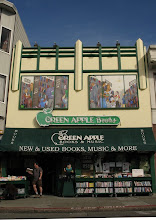
Saturday, February 27, 2010

Standing the Test of Time

My associate Pete wrote last week about books in the "1,000 copy club," that is, books that Green Apple has sold more than a thousand copies of over time. The book in question was If You Want to Write by Brenda Ueland, first published in 1938. Published over 70 years ago, it still outsells (at least here at the Apple) every other writing book published since, including books by much more successful authors like Stephen King and and Elmore Leonard.

So what other books are there like that, written over 50 years ago but still setting the standard in their field? The first one that comes to mind is The Joy of Cooking, originally written in 1936 (and revised a few times since then), it
continues to be one of our top 5 cookbooks every year, year in and year out, no matter what other cookbooks come along and catch the public's fancy and sell well for a while and then disappear.

Another candidate would be Strunk and White's The Elements of Style. This one is from 1918, and though other usage guides have come and gone, nobody seems to have said it as well as these boys.

My last candidate is a bit more obscure- Calculus Made Easy (as if). While we don't sell nearly as many copies of this as we do of the above-mentioned books, it still sells a few copies every year, exactly 100 years after it was originally published.

I'm not saying these are the best books in their respective categories. It's just that, for whatever reason, they have caught the book-buying public's fancy. Friends recommend them to friends, generation upon generation. Can anyone think of other books that fall into this category?

Friday, February 26, 2010

Join me for a drink?

I’m growing more and more impressed with the quality and uniqueness of literary events in the Bay Area these days - impressed yes, but not surprised… In a city that leads the rest in dollars spent per capita on books and booze, I’ve come to expect (and also work hard to organize) authors from far and wide pimping their wares in watering holes that range from dive bars to speakeasies to penthouses to cafes. If there’s a table and a stage – OK, maybe some haven’t had a stage, but still – literature in The City flows like fine wine; or at least MD2020.

Over the past couple of months I’ve attended sold-out Literary Death Matches, a packed Porchlight and a really rambunctious Quiet Lightning. Sad that I missed the most recent Writers With Drinks, but I do believethat I'll be there next time...

So when I encourage you to brave the rain tonight and join me at The Knockout for another in the continuing Drinks With Tony series, you know that I know what I’m talking about. Tony Dushane has been recording a live talk-radio show there for some time now, but tonight’s scene will be a bit different, as we’re celebrating the release of Tony’s new book, Confessions of a Teenage Jesus Jerk – his memoir of growing up Jehovah Witness. Interesting, indeed! Joining Tony on stage this evening will be Alan Black, Harmon Leon and Marisa Matarazzo with musical guests Vagabondage.
Tonight's event is FREE, so please try and make it down and support your local scene!

Wednesday, February 24, 2010

ANDERS NILSEN

I've been pretty heavily in to the work of Anders Nilsen for a little over a year now, and since I just can't get every little thing of his in to the store (much is out of print) I'm putting the spotlight on his work today. You might recognize his illustrations from a book cover or three, such as Ron Currie Jr.'s book God is Dead, his award winning cover (at the NY Book Fair) for Armitage's translation of The Odyssey, or perhaps the recent Penguin reissue of Hans Christian Andersen Fairy Tales. Whether you have or haven't heard his name I highly recommend you look further in to his work. Green Apple carries his most recent graphic novel Dogs & Water, which I can attest for myself is mighty good.

For a little more info on the guy, his website is here. His blog, in which he writes on his own work as well as others, is here.

Monday, February 22, 2010

Poem of the Week by e.e. cummings

One of my favorite poets is e.e. cummings. I'm drawn to his playfulness with language and his humor, and also to the occasional lustyness of his poetry. A newly released collection called Erotic Poems gathers 50 of his romantic and lusty poems along with 12 drawings by the poet.

there is a
moon sole
in the blue
night

amorous of waters
tremulous,
blinded with silence the
undulous heaven yearns where

in tense starlessness
anoint with ardor
the yellow lover

stands in the dumb dark
svelte
and
urgent

(again
love i slowly
gather
of thy languorous mouth the

thrilling
flower)

Sunday, February 21, 2010

Literary Quotes

One of my favorite all time quotes from Herman Melville's Moby Dick: "All our arguing with him would not avail; let him be, I say: and Heaven have mercy on us all—Presbyterians and Pagans alike—for we are all somehow dreadfully cracked about the head, and sadly need mending."

From John Steinbeck's East of Eden: "It is true that we are weak and sick and ugly and quarrelsome but if that is all we ever were, we would millenniums ago have disappeared from the face of the earth."I'm not sure which of the English translations has this Georges Perec quote, in French the book was L'Infra-ordinaire: "What we need to question is bricks, concrete, glass, our table manners, our utensils, our tools, the way we spend our time, our rhythms. To question that which seems to have ceased forever to astonish us. We live, true, we breathe, true; we walk, we go downstairs, we sit at a table in order to eat, we lie down on a bed on order to sleep. How? Where? When? Why?"

Saturday, February 20, 2010

Gung Hay Fat Choy


A lot of independent bookstores are struggling in these tough economic times. Competition from the big chains, Amazon, e-books: it all chips away at the bottom line. But at Green Apple, we're holding our own. One might ask the secret of our success. Is it our business acumen? Our aggressive marketing? No, it all comes down to The Lion Dance. Every Chinese New Year, members from local martial arts clubs come around and, for a small donation, perform a Lion Dance in the entryway of the store and set off some firecrackers to ward off the evil spirits. This ensures good fortune for the coming year. So Gung Hay Fat Choy, everyone. For a good book on Chinese New Year, check out Celebrate Chinese New Year by Carolyn Otto.

Wednesday, February 17, 2010

THE SUPERMALE

My latest staff pick, Alfred Jarry's The Supermale, just showed up at Green Apple the other day. A pioneer of the surreal and absurd in his time, Jarry was a notable figure in Paris. A drunken showboat, a rampaging cyclist, a brilliant author, an irresponsible owner of firearms. A destined pauper and a lifelong midget, his mere existence was controversial in the time of his life (1873 -1907).

Recently reprinted, in Jarry's fashion The Supermale still remains equally hilarious and bizarre. Some wary readers may be deterred as it is often cited as 'the first cyborg sex novel,' but really, don't let that stop you, your friends, your family or pets. Insanity, blasphemy. Whatever. It's been over one hundred years since the book was published and it still holds up as more clever than the bulk of literature published in the last ten.

Below is a quick short story by Jarry to give you glimpse of what you're in for. To read about the man himself, click his name below (highly recommended).

THE PASSION CONSIDERED AS AN UPHILL BICYCLE RACE

By Alfred Jarry

Barabbas, slated to race, was scratched.

Pilate, the starter, pulling out his clepsydra or water clock, an operation which wet his hands unless he had merely spit on them -- Pilate gave the send-off.

Jesus got away to a good start.

In those days, according to the excellent sports commentator St Mathew, it was customary to flagellate the sprinters at the start the way a coachman whips his horses. The whip both stimulates and gives a hygienic massage. Jesus, then, got off in good form, but he had a flat right away. A bed of thorns punctured the whole circumference of his front tyre.

Today in the shop windows of bicycle dealers you see a reproduction of this veritable crown of thorns as an ad for puncture-proof tyres. But Jesus's was an ordinary single-tube racing tyre.

The two thieves, obviously in cahoots and therefore 'thick as thieves', took the lead.

It is not true that there were any nails. The three objects usually shown in the ads belong to a rapid-change tyre tool called the 'Jiffy'.

We had better begin by telling about the spills; but before that the machine itself must be described.

The bicycle frame in use today is of relatively recent invention. It appeared around 1890. Previous to that time the body of the machine was constructed of two tubes soldered together at right angles. It was generally called the right-angle or cross bicycle. Jesus, after his puncture, climbed the slope on foot, carrying on his shoulder the bike frame, or, if you will, the cross.

Contemporary engravings reproduce this scene from photographs. But it appears that the sport of cycling, as a result of the well-known accident which put a grievous end to the Passion race and which was brought up to date almost on its anniversary by the similar accident of Count Zborowski on the Turbie slope -- the sport of cycling was for a time prohibited by state ordinance. That explains why the illustrated magazines, in reproducing this celebrated scene, show bicycles of a rather imaginary design. They confuse the machine's cross frame with that other cross, the straight handlebar. They represent Jesus with his hands spread on the handlebars, and it is worth mentioning in this connection that Jesus rode lying flat on his back in order to reduce his air resistance.

Note also that the frame or cross was made of wood, just as wheels are to this day.

A few people have insinuated falsely that Jesus's machine was a draisienne, an unlikely mount for a hill-climbing contest. According to the old cyclophile hagiographers, St. Briget, St. Gregory of Tours, and St. Irene, the cross was equipped with a device which they name suppendaneum. There is no need to be a great scholar to translate this as 'pedal'.

Lipsius, Justinian, Bosius, and Erycius Puteanus describe another accessory which one still finds, according to Cornelius Curtius in 1643, on Japanese crosses; a protuberance of leather or wood on the shaft which the rider sits astride -- manifestly the seat or saddle.

This general description, furthermore, suits the definition of a bicycle current among the Chinese: "A little mule which is led by the ears and urged along by showering it with kicks."

We shall abridge the story of the race itself, for it has been narrated in detail by specialized works and illustrated by sculpture and painting visible in monuments built to house such art.

There are fourteen turns in the difficult Golgotha course. Jesus took his first spill at the third turn. His mother, who was in the stands, became alarmed.

His excellent trainer, Simon the Cyrenian, who but for the thorn accident would have been riding out in front to cut the wind, carried the machine.

Jesus, though carrying nothing, perspired heavily. It is not certain whether a female spectator wiped his brown, but we know that Veronica, a girl reporter, got a good shot of him with her Kodak.

The second spill came at the seventh turn on some slippery pavement. Jesus went down for the third time at the eleventh turn, skidding on a rail.

The Israelite deminondaines waved their handkerchiefs at the eighth.

The deplorable accident familiar to us all took place at the twelfth turn. Jesus was in a dead heat at the time with the thieves. We know that he continued the race airborne -- but that is another story.