
Books, and literature in this specific case, can oftentimes transcend (for lack of better words) the means of its original presentation (i.e. book-->music, film-->book). Jean-Phillipe Toussaint's, Bathroom, can easily be compared to John Cage's 4'33. The narrator of, Bat
hroom, is excited by smallest of details due to where he is: the bathroom. Cage's piece is meant for the listener's experience to be based on the sounds occurring during the performance. Both are drastically affected by their surroundings. (The photo to the right is of Cage's performance of "Water Walk" in 1960).
Most fiction written by Haruki Murakami never fails to remind me of Wong Kar Wai's films. The dreaminess which Wong Kar Wai creates visually, is akin to the emotion Murakami pens. Even the Twilight series has forced readers to look for music which emulates (in one way or another) the books.
Obviously there are far more educational studies on this topic and I may just be rambling, but isn't it the stuff like this that gets you thinking, really thinking? What books remind YOU of other ideas/music/films/art?
Showing posts with label Stefano Benni. Show all posts
Showing posts with label Stefano Benni. Show all posts
Thursday, March 18, 2010
Comparisons
I was cleaning my room recently and found a number of books I haven't touched in quite some time, Margherita Dolce Vita by Stefano Benni (who I've mentioned before) being one of them. Staring at the book made me think about its plot, characters and general form which Benni forced into my brain (the big, black, giant cube), when suddenly I couldn't stop of Montreal from playing loudly in my head; of Montreal's music somehow pinpoints the exact feel of Benni's story, its perfectness is uncanny.


Thursday, October 1, 2009
Everybody Poops
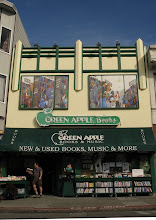
Though it may be a bit on the smelly side, poop is the topic of today's post. It's kind of gross, not very cute to look at, but everyone poops (Taro Gomi agrees with this last statement) and Green Apple, surprisingly or not, stocks quite a few books about it. What inspired my musings on this topic stems from reading probably the best...taking-a-dump scene I've ever come across in literature. Poop and literature, you ask? Yes, it's true.

Stefano Benni's Timeskipper tells the story of a young boy who is lucky to have a duoclock, or the ability to speed time up or down into the future or the past as he pleases. About three pages into the book, Timeskipper describes this scene as he hop-skips down the hill to school (and my apologies if anyone finds the following too lewd):
A rainbow? Birds chirping festively? I bet this just ruined your appetite for polenta! Even though your appetite may be ruined, one must admit that Benni's described act-of-crap paints quite the picture.
A big seller at the store is What's Your Poo Telling You? (courtesy of Chronicle Books), which has an illustrated description of at least two dozen dookies and discusses what can be learned about health based on what ends up in the bowl.
Want to know the history about poop? Take a look at Poop: A Natural History of the Unmentionable by Nicola Davies. According to Davies, "hippos navigate by it, sloths keep in touch through it, dung beetles eat it." The inside cover of this book should also be noted, as it's the most magnificent shade of poop brown.

Stefano Benni's Timeskipper tells the story of a young boy who is lucky to have a duoclock, or the ability to speed time up or down into the future or the past as he pleases. About three pages into the book, Timeskipper describes this scene as he hop-skips down the hill to school (and my apologies if anyone finds the following too lewd):
The cloud-man smiles at me straight away, and it is clear that only a god could smile like that. Then he squats down on the hillock, silhouetted against the light, surrounded by heliotrope and chicory, and tugs down three or four different varieties of trousers and underpants, and then he starts taking a crap. And not just any old crap, the mother of all dumps: it looks like an anaconda unwinding, or kernels of corn pouring out of a combine harvester, or warm polenta being tipped out of a huge pot; it's a spectacular triumph of lukewarm shit, and when it spreads out on the ground it unleashes an immense and aromatic mist of steam, and the more he craps the more the steam spreads, settling onto the meadow and the trees and fogging up the shells of the snails. And still he craps, a volume of shit that is just unbelievable, while the dog looks over at me as if to say, ah, this is nothing and by now you can't even see the man anymore, just a huge cloud of steam with a rainbow running through the center of it. From the mist comes a labored, rapid panting that means he is still shitting, and birds fly around the cloud, chirping festively (Benni, 16).
A big seller at the store is What's Your Poo Telling You? (courtesy of Chronicle Books), which has an illustrated description of at least two dozen dookies and discusses what can be learned about health based on what ends up in the bowl.
Want to know the history about poop? Take a look at Poop: A Natural History of the Unmentionable by Nicola Davies. According to Davies, "hippos navigate by it, sloths keep in touch through it, dung beetles eat it." The inside cover of this book should also be noted, as it's the most magnificent shade of poop brown.
Subscribe to:
Posts (Atom)


 Posts
Posts

