Showing posts with label sparks. Show all posts

Saturday, April 7, 2012

"There is a pleasure in the pathless woods"

Photo by Bryan Larson

I've always thought that one of the questions our HR manager should ask potential employees during their interview is, "How good are you at giving directions?" This, because without a doubt the question we're most frequently asked is, "Where are your ____ books?" (Health, business, science fiction, philosophy, &c.) I answer this request often enough that it seems like just about everyone who comes into the store is here for the first time, newly arrived and wide-eyed.

We more than welcome new customers, of course, and it's natural that those who frequent the store are more aware--even if only vaguely--of Green Apple's layout, as shifting and possibly inscrutable as that may be (sometimes even for those of us who work here). Which is to say that the frequency of this question seems to be a good sign for us; the day no one asks where, for instance, poetry is will surely be a sign of impending doom.

And while we've stenciled apples onto floors, given names to parts of the store, printed maps, and slapped signs (atop of older signs, next to newer signs) to the walls, the fact of the matter is that even with all of these helpful pointers, bookstores are, to my mind, the most difficult retail environment to navigate. By difficult I don't mean troublesome, but tricky, like following an overgrown path through a forest. The person who asked at the front counter where writings on nature are will, by the time he or she gets upstairs, have been so sidetracked as to have already forgotten where we were sending them.

This is why so many people speak fondly of getting lost in a bookstore or why we browse for books: I've never heard someone say they're browsing for a pair of jeans.

But we do technically browse for jeans. And we do technically search for books. The difference that exists between the two, I think, is the receptivity the bookstore fosters, the sense of wandering and happy discovery that exists in a space that, Borgesianly, opens up to infinity. Think about the contents of a bookstore: pages upon pages full of dreams, plots, characters, facts, photographs, indexes, footnotes, reaching back into history, forward into the future, stretching out across the present, or into other impossibilities. It's dizzying, yet we invite it. We seek it out.

Rather than coming to any conclusions here--I may not have had even one to draw--I'm going to let this meandering post mirror the way we experience bookstores, and conclude an excerpt from Lo Chih Cheng's "Bookstore in a Dream":
The forest that awes and fascinates us the most
is this bookstore...

Nobody, not even the 89-year old third-generation
shopkeeper, Mr. L.,
Nobody knows the bookstore's true dimensions--
not even the literature Professor T., who last
year in pursuit of some
remaindered book,
was submerged forever in the quicksand of letters,
or the critic who, after many years, came dashing out of a
mural
or the new breed of bats biting his neck...
Really, even in the closely guarded stacks east of Section
B--
in the shrubbery, mainly of biographies and fables--
we will occasionally run into the
skeletons of the lost...

Friday, March 9, 2012

On Going Out-of-Print

What's the average lifespan of a book?

I'm not referring to the length of time a book can survive in a library or private collection, but the time between a book's publication and its eventual, inevitable obsolescence. How many novels published twenty years ago are still in print today? How many from two years ago, even? (At the moment, I'm only considering books published traditionally by publishing houses, not Print on Demand titles--even though POD technology is rapidly changing the way we conceive of the life cycle of a book.)

Without any recent statistics (or, rather, the motivation to dig them up), I'd be hard-pressed to come up with anything more than an educated guess, but I doubt I'd be too far off by estimating that 70-80% of books don't stay in print for more than a few years. If we limit the discussion to novels, I think this number may be even higher.

This isn't to say that a book's death is necessarily a tragic event--at least not for those of us who feel overwhelmed by the enormous quantity of books being published every year (close to 300,000 in the U.S. alone, according to UNESCO). A book's author suffers, I'm sure, and every book has at least one or two devoted readers who will lament its passing, but the fact is that most books are published, sell poorly, then fade into oblivion, perhaps to be resurrected later. It's the natural progression.

In the abstract, this all sounds like a fine argument for the obvious necessity of a sort of literary Darwinism, in which the fittest survive and the weaker go the way of the dodo. But as a bookseller, I've seen too many fine books slide into oblivion to believe that fitness, to extend the metaphor, is the most important characteristic of a book's continuing existence. Unless we're okay with equating fitness to sales figures (I'm not), what do we make of a masterpiece like Dino Buzzati's The Tartar Steppe--a novel as perfect and haunting as Albert Camus' The Stranger--being permitted to slowly fade into obscurity?* Or one of my recent staff favorites, Roland Topor's cult classic The Tenant, which we sold hundreds of copies of before it too became a ghost? Or, to use another personal example--and the impetus behind this post--what of Wilcock's Temple of Iconoclasts, a book Roberto Bolano called "one of the funniest, most joyful, irreverent, and most corrosive books of the 20th century"? (Our inventory tells me we have one left on the shelf, so if you want it, come and get it.)

By nature, this consideration is very personal: these are all books I've loved and done what I could to pass on to other readers. Yet they have nevertheless gone out-of-print. What's a bookseller to do in this situation? Feel guilty that I couldn't more convincingly persuade you to read them? Or feel humble pride that I was able to sell the copies I did? In a paradoxical sense, the guilt I feel is less for my inability to turn these books into bestsellers than it is for speeding them along the road to oblivion: if we'd sold fewer copies, they'd still be on our shelves--for a while longer, at least.

In the end, my only recourse may be to lament all the factors that lead to a book's death--the cost of printing, warehousing, and distribution; the sometimes odd constraints of acquiring rights; the difficulty of getting a book noticed among the avalanche of other books; our suffocating copyright laws. It's a helpless feeling, but more than ever, with the POD technologies mentioned above and the increasing digitalization of books, it may be that in the future we'll look nostalgically at the days when books had a lifespan. It may be that in a subtle way, the threat of disappearance is part of the reason we so cherish the books we love.


___

* Buzzati's novel is technically listed by its publisher as being Out of Stock Indefinitely, which is a polite way of saying "We're waiting to pull the plug." My inquiry to the publisher, David R. Godine, about the status of the book wasn't answered.

Friday, February 24, 2012

Facts stand no chance


John D'Agata, a professor of creative writing at the University of Iowa, writes essays, but not the kind you remember composing in school. His particular style of essay--which he calls "lyric"--blends fact and, well, something on a continuum of fact and if not fiction, something more akin to it than nonfiction, to convey what he feels is the essence of what he's exploring. D'Agata's stance, which he argues is valid based on the etymological and historical sense of "essay," a verb synonymous with trial, test, and attempt, is that the Truth of a matter cannot solely be conveyed through empirically verifiable facts.

Some, including Jim Fingal, the Believer fact checker assigned to research the contentious essay at the center of this book, take issue with D'Agata's playing fast and loose with our mutually shared reality. Fingal, NY Times Book Review editor Jennifer McDonald, and others point to the troubling aspects of D'Agata's process, arguing that blurring the lines between fact and fiction may be aesthetically justifiable, but is morally questionable. D'Agata counters with the argument that he's never claimed to write non-fiction, only essays. And essays are a genre of their own, amorphous, personal, drawing on myth, poetry, and imagination as well as facts (as commonly understood) to portray the richness of life--or, in the case of the essay under the microscope here, death.*

These fundamental differences in opinion create a dynamic tension in this record of D'Agata and Fingal's dialogue about the essay in question, which would later become a critically lauded book, About a Mountain. What starts innocently enough, with a bright-eyed intern's attempt to iron out some seemingly straightforward facts (are there 31 or 34 strip clubs in Las Vegas?), by the end has taken on a much larger meaning, becoming a tense ideological and aesthetic battle about the nature and value of art, truth, and meaning.

The text on the page of Lifespan of a Fact is neatly arranged, with the back-and-forth between Fingal and D'Agata surrounding the essay, marginalia that overwhelms the text. I'll refrain from drawing my own conclusions here, but am curious as to what other readers think, whose side you fall on. Are facts negotiable? Do they matter in a work of art? Is truth only what's verifiable, or are there truths of feeling? These are big questions, of course; Lifespan of a Fact is a compelling contribution to this age-old debate.


__

* The argument D'Agata makes would be more acceptable in France, where a genre-bending category of literature called l'autofiction has become increasingly common in recent years.

Friday, February 17, 2012


On Thursday, I was lucky enough to be able to attend one of the Center for the Art of Translation's Lit & Lunch events with translator and poet Richard Howard. As many of you may know, Mr. Howard is an accomplished translator of French poetry and literature, notably introducing American readers to the works of Alain Robbe-Grillet and Nobel Prize winner Claude Simon, as well as rendering canonical works by Baudelaire, E.M. Cioran, Camus, Foucault, and Roland Barthes into English. His latest project, in fact, is a translation of Barthes' complete Mythologies, due next month. (Can you believe we've been reading an incomplete text of Mythologies all this time?)


And, for good measure, he's also the translator of the beloved Little Prince, a fact I just learned. As a poet, he's proven himself equally adept, winning the Pulitzer Prize in 1970.

At yesterday's talk, a free event held at 111 Minna, Mr. Howard spoke of the vagaries of translation, focusing specifically on the difficulties presented by Stephane Mallarme. He also gave an account of a scandalous 1912 balletic adaptation of Mallarme's poem "The Afternoon of the Faun" during which Nijinsky simulated masturbation.

One of the more entertaining moments of Mr. Howard's talk came during a discussion of "three old men" who influenced his reading and writing. One was his grandfather, a great book collector in the 19th-century mold; another a professor at Columbia in the 1940s; and the third, much to my delight, was a bookseller, Richard Laukhuff. Laukhuff, a German immigrant who settled in Cleveland, seems from what I can gather to be one of those legendary early-20th century figures who took bookselling with a seriousness that seems almost unfathomable now. His eponymously named store specialized in carrying challenging and often hard to find literature. If you were an Ohioan in the 1920s and wanted to find something by that smutty Jimmy Joyce, you went to Laukhuff's. Hart Crane apparently knew this; he frequented Laukhoff's Bookstore. The incident that Mr. Howard related is of a more mundane moment in bookselling, one that hearkens back to a different era.

One afternoon, while Richard and his mother were in the shop--the Howards were family friends of the bookseller and his wife, both of whom, according to Howard, "never left the shop"--a woman inquired about purchasing a Bible. Laukhuff, who was sitting behind the counter, turned down the woman's request. After the customer left, Mrs. Howard, who knew that there were indeed Bibles in the store, asked Laukhuff why he would send the woman away empty-handed. To which he replied, "There are some days when one doesn't feel like selling a Bible."

* * *

If you're interested in more events like this one, including an upcoming conversation between Haruki Murakami's collaborative translators Jay Rubin and J. Philip Gabriel (April 3), check out the Center for the Art of Translation's events page or consider donating to this fine non-profit.

Friday, February 3, 2012

The Ice Balloon


Come January, I usually start getting a little nostalgic for the winter everyone back home on the east coast seems to be suffering through grumpily. This year was no different, so I decided to chill myself vicariously--the best kind of chill--by indulging in a little polar exploration from my armchair. Fortunately, Alec Wilkinson's The Ice Balloon arrived just in time to allow me this indulgence.

The history of polar exploration is largely a history of successive catastrophes. From Sir John Franklin's ill-fated attempt to find the fabled and, it turns out, utterly impractical Northwest Passage to Robert Scott's stubborn demise in Antarctica, the poles have withstood a great deal of human ingenuity and determination. Wilkinson's account of S.A. Andree's ambitious and novel attempt at the North Pole--he was the first to try it using a balloon--is the chronicle of another disaster, but one that comes alive in the telling with an unexpected degree of suspense.

Andree is presented as the first non-Romantic explorer, one whose faith in science and technical progress led him to believe almost dogmatically in the success of his expedition. (He was so confident of his success, in fact, that he brought a tuxedo along with him, certain he'd have reason to don it for a celebrated return to civilization.) And, in the story as Wilkinson tells it, it seems Andree had sufficient reason to believe in the success of his voyage.

By weaving into the narrative covering Andree's attempt--which includes several poignant biographical sketches--other episodes from the "golden age" of polar exploration, Wilkinson presents not just a vivid biography of a man, but of the obsession of an age and the characters who acted out the often harrowing consequences of that obsession.


Visit this page for more photographs of Andree's doomed expedition (which were discovered nearly 40 years after its mysterious demise).

Friday, January 20, 2012

Ugly Books

"An indescribable joy always rushes out of great books, even when they speak of ugly, hopeless, or terrifying things." -- Gilles Deleuze


I'm reading a book called Assisted Living. It was just published by the envelope-pushing Dalkey Archive (for example, see this and this and this), was written by a Swedish author using the pseudonym "Nikanor Teratologen", and, even in our age of gratuitous violence and unapologetic vileness, is proving itself to be full of outrageously cringe-inducing moments. Without ruining the plot--however tenuous it may be--it's fair to sum up the novel as being a parade of debauchery, rape, sacrilege, pedophilia, racism, murder, and more. Name the vice and you'll likely be able to open a page at random and find an instance of it.

It's an ugly book.

Appearances aside, Assisted Living may represent a subtle critique of liberal democracy and the free market; it may expose the lurking dangers of fascism; it may be an outlandish commentary on the perennial battle of the generations; its excesses may even prove to be so cartoonish as to be a lampoon of such writing. I'm certain arguments can and will be made for all of these interpretations and more, but in the moment of reading, I find myself wondering: Why?

Not so much why write an ugly book, but why read it? To modern ears, it may sound naive to speak of the redemptive qualities of art, but I wonder if we've really moved beyond thinking that a book (or any piece of art) should serve a purpose, whether moral, instructional, or purely aesthetic. (And, despite its vileness, Assisted Living does have its literary qualities.) If we accept this as a valid question, what are we to make of books like this? Why do we read them? More personally, why do I read them?

I read ugly books.

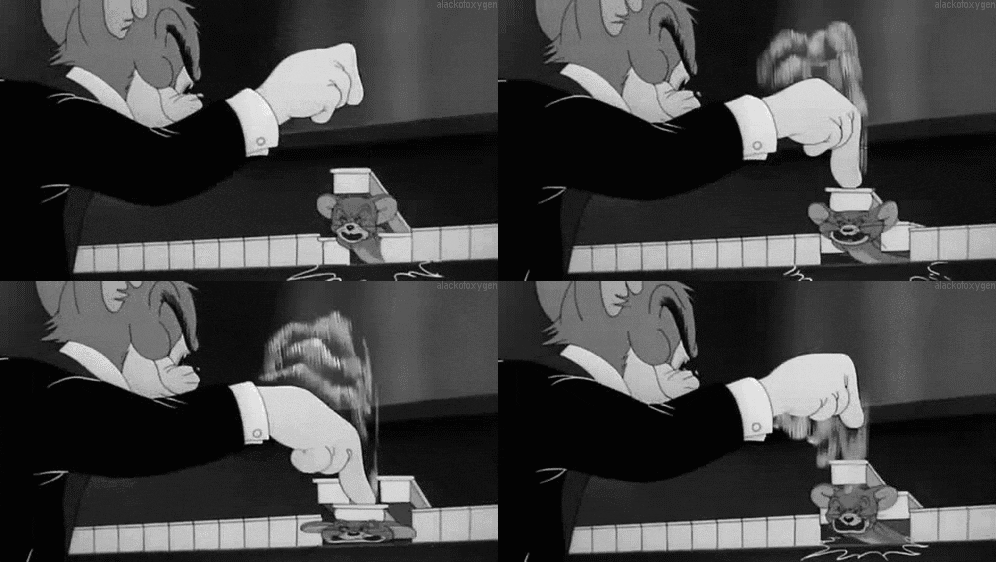
The cartoonish violence and excesses of Assisted Living may not be my typical fare, but the works of some of my favorite writers--Thomas Bernhard, Michel Houellebecq, and Angela Carter to name a few--can certainly be ugly other, possibly more damaging ways. After all, we're desensitized to violence pretty early on, whether through Tom & Jerry or Mortal Kombat, but the kind of bleakness in the work of these authors is altogether of a different, more corrosive variety. For instance, I've found that I need to allot myself several months between readings of Bernhard; otherwise I find myself on edge, depressive. I don't think this is an uncommon reaction to his work.

So why do I continue to read them? Because I prefer my humor black? Do I think that cruelty and violence are capable, in art, of shocking me into a more grounded awareness of the world? Or that works like this will rattle my complacency or awake me from my dogmatic slumber? A punch in the face does provide pretty indisputable evidence of being alive.

This raises the question, of course: do we need an occasional jolt of ugliness (in the form of a bludgeoning book like Assisted Living) to keep our desire for endless beauty in check? Is ugliness necessary?

Wednesday, January 11, 2012

By the book

There's a bibliomantic meme spreading around the internet (or at least Tumblr) that states the following: "Open the closest book to page 45. The first sentence will describe your sex life for the following year."

Naturally, I played along, opening The Wild Girl, Natural Man, and the Monster (thinking that with a title like that, there's got to be something good in store) to page 45, wherein I found the following sentence:
Once the girl is labeled an Eskimo (more precisely, a native of slightly less ferocious Labrador), her strangeness dissipates and her assimilation takes on greater value.
Seems like 2012 is going to be... hot? Weird? Both? ("... her assimilation takes on greater value.") Maybe I need more exciting bedside reading.

But some of the people I informed of the meme seem to be on their way to much less ambiguity (and, possibly in the case of the next quoted sentence, more profit) in their sexual future. For instance, the first sentence on page 45 of that classic culinary standby, Joy of Cooking, supplies one reader with the following:
Informal opportunities for comparisons abound: Walk-around tastings are increasingly popular, often as fund-raisers.
Another, er, culinary delight, which I was told of by one of our sales reps this morning, comes from Simonetta Agnello Hornby's novel, The Nun:
"Ah, how I love swordfish," Annuzza murmured, licking her wrinkled lips, certain she could already taste it.
As I was typing this, I explained the meme to a Green Apple employee shelving nearby. Perhaps unluckily, he was holding a India Calling, which informs him rather literally that:
The dependency scares you, as a needy lover's demands scare you, for it suggests a bottomless pit of giving that will devour you if you give in just slightly and allow yourself to care.
And, finally, another friend happened to have David Burns Feeling Good at hand, and was told unequivocally,
You are lonely and you decide to go to a social affair for singles.
I could do this forever. But now it's your turn.

Saturday, December 31, 2011

Happy New Year!

We send you out into the night and into 2012 with our top ten bestselling Staff Favorites of the past year. Thank you for continuing to shop at Green Apple. We look forward to sharing some new favorites in the year(s) ahead.

With an honorable mention to a plucky favorite that missed out by a few copies to the Eliot Weinberger book above. (Though we're open for 3 more hours if anyone wants to see Barbara Comyns' novel crack the top ten...)

Wednesday, December 21, 2011

The Best Books We Read 2011

In the Poetics of Space, one of the most achingly perfect books I read this year, Gaston Bachelard writes the following, which applies almost exactly to the best book I read in 2011:
Every good book should be re-read as soon as it is finished. After the sketchiness of the first reading comes the creative work of reading. We must then know the problem that confronted the author. The second, the third reading... give us, little by little, the solution to this problem.
Although I haven't found the "solution" to the problem that inspired Stanley Crawford's Log of the S.S. The Mrs Unguentine, each voyage--I read the book three times in succession this summer, after reading it initially, and a little skeptically, in 2008 when it was first reprinted by Dalkey Archive Press--brought me closer to some essential truth about the prickly dilemmas inherent in human relationships and cohabitation.

The plot of Unguentine is as deceptively simple as a creation myth and has the flavor of one as well: Mrs Unguentine (always Mrs) recounts her seafaring adventures--which are simultaneously her domestic adventures--with her husband, Unguentine (never Mr), a man who "grew nauseous upon land" and so took his wife to sea, fitting out a barge with increasingly elaborate gardens and mechanical devices. In time, the pair become famous in port cities across the world, their home in turn a curiosity, a place of ill-repute, a smuggler's ship. The notoriety eventually dissipates, leaving their self-contained ecosystem a world unto itself; all the better as far as Mrs Unguentine is concerned--even if her good riddance has something wistful to it.

Into deeper and lonelier waters the Unguentines then sail. In an episode that will resonate with anyone who has found him or herself in a relationship that seems to have gone off course, Mrs Unguentine discovers a blank map by which, it seems, her husband is steering. (A map that alludes, possibly, to another.) Silence grows between the couple just as the trees Unguentine has planted grow to render clear navigation impossible. Ages pass, time stops; the barge becomes more and more isolated. Unguentine and everything familiar disappears, then possibly reappears.

What Crawford has managed in this slim and perpetually overlooked book (of just over 100 pages) is marvelous. As with the best allegories, those that lend themselves to multiple and endless interpretations, Log of the S.S. The Mrs Unguentine can be read literally--as a seafaring tale, a creation myth, the story of an unusual marriage--and rooted around in for deeper meaning, each reading revealing just how dense, under its reflective surface, the novel really is: an amalgam of Adam and Eve, Noah and the Flood, Ulysses' journeys, Ahab's quest...

Vija Celmins, Untitled (Ocean), 1977 (graphite on paper)

Near the end of the book, Mrs Unguentine wonders, "what would it be like to live without the presence of the sea?" which seems to me a question that perfectly embodies everything I love about this novel. It's a straightforward, if complicated, question and one that brings a reader to a similar precipice: what would it be like living without the presence of a book like this?

Saturday, November 26, 2011

A slipcased sea


With the exception of a year in the Midwest, I've spent all of my adulthood living at most a few miles from a coast. Yet even when I could hear the Atlantic's staticky, nor'easterly roar from my bedroom window in New Jersey or now, when on clear days in San Francisco I can see the Pacific from the roof of my building, I've always wanted a tangible object to keep close by.

We all know people who collect shells or stones or driftwood. (I remember very distinctly my grandmother's homemade shell-filled lamp.) I'm a book person, so it's perhaps unsurprising that I've always desired to have the sea between the pages of a book.

Until now, though, I've never acted on that desire, maybe because I felt caught between the atavism and the consumerism of the impulse (as if any object, especially a photograph, can properly capture The Sea), or because I've never quite found the perfect book, despite there being no shortage of such collections. Besides, let's face it, there is also a lot of sentimentality about the sea; romance as well, but rarely romance that doesn't devolve into hackneyed phrases and imagery.

This book, though. This is the one. It's full of romance that steers clear of the dangerous shoals of sentimentality; it's got grandeur and shipwrecks and symbolism; it evokes the real sublimity and ordinariness of of the sea, while managing to permit it its dream quality. It's also got a slipcase. (A slipcase, I say!)

Francis Mortimer, The Wreck (1911)

Adolf Fassbender, Crashing Wave (c. 1930)

Hiroshi Sugimoto, Black Sea, Ozuluce (1991)

Saturday, October 1, 2011

For a man that never wanted to be born, Tristram Shandy has aged quite well.

Tristram Shandy turned 250 this week. Consider this a roast of sorts.


"Nothing odd will do long. Tristram Shandy did not last."
- Samuel Johnson

"The man Sterne is worth 1000 Pedants and commonplace-place fellows like Dr. J[ohnson]."
- Arthur Schopenhauer

"Tristram Shandy is the most typical novel of world literature."
- Viktor Shklovsky


Tristram Shandy is the "undoubted progenitor of all avant-garde novels of our century."
- Italo Calvino


"[I]t is my best text."
- Javier Marias, on his translation of Tristram Shandy into Spanish


Tristram Shandy is "the best Book, that has been writ by any Englishman these thirty Years, bad as it is."
- David Hume


Monday, September 19, 2011

Colophonic Spree

I feel your pain, bro.

One of my least favorite tasks at the store is sorting piles of books to be returned, a chore that more than any other feels equal to some of the cruel, eternal punishments dished out by those inventively sadistic Greek gods. Shelving is likewise never-ending, but is at least alleviated by constant novelty. Shuffling books around the display tables in an effort to keep things fresh and interesting appeals to the Tetris-lover in me. But sorting returns is a downer.

It's not merely that I have a soft spot for those underselling books that, having been given a fair chance on our shelves, are now to be banished to the dusty gloom of publishers' warehouses. I'll occasionally feel a twinge of remorse--I should've tried harder to convince people of your worth, poor, abandoned
Marcel Schwob!--but you can get pretty callous in this business.

The hardness of my heart notwithstanding, what I intend to write about today are publisher's
colophons, which are the first and quickest means I have of whittling down these ever-growing piles of books labelled with that kiss of death: TO BE RETURNED. When I find our returns sorting table creaking under the weight of hundreds of books that have failed to catch enough readers' eyes to stave off damnation for at least another few months, my quickest recourse is to roll up my sleeves and begin the sad process by plucking books from the piles by sight. To do this, I scan the spines for distinctive colophons.

It's a lamentable fact, maybe, that this is if not the only, then at least the most common time I pay attention to colophons. Because there is an art to the colophon that I appreciate as a bibliophile. (I remember as a younger reader scanning the shelves at my local, now defunct, Borders for the first image below, assuming that anything New Directions published was worth my attention.) But as a seasoned bookseller, I'll admit to using these identifiers more practically.

But! Wait! Please don't assume I provide the following logos simply because they are instantly identifiable and save me a few minutes when I'm playing book undertaker. A colophon is not necessarily a
black spot signaling doom. Those below are a few that I find charming, distinctive, or seminal.

The old New Directions colophon

The new New Directions colophon


A classic classic

A classic-er classic

It's true: owls think they're smarter than us

One fish (F), two fish (S), three fish (G)

For more colophons from the 1940s and '50s, visit The Design Observer.

And, to offset the risk that I've inadvertently created a subconscious association in your mind between a book's doom and the colophons pictured above, I'm including a completely gratuitous video of a cat stalking a few green apples. Enjoy!


Saturday, September 3, 2011

Introducing the Cahiers Series


Booksellers take great pride and pleasure in introducing readers to books they may otherwise overlook. Sure, we love the latest buzzed-about blockbuster, but there's a special place in our heart for the underdog: the overlooked small press gem, the unjustly neglected classic, the locally produced 'zine.

So while the deservedly hyped Ready Player One is our guaranteed choice for September's "Book of the Month" (more on this in an upcoming post), I want to take a moment to introduce a series of pamphlets published by Sylph Editions in conjunction with the Center for Writers & Translators at the American University of Paris: the Cahiers.

A page from Cahier 5

The Cahiers Series, totaling sixteen published volumes with another on the way this fall, is aimed at exploring the interstices and intersections between writing and translation. With beautifully illustrated essays (etc.) by noted translators (Richard Pevear and Lydia Davis, for example), poets (Alan Jenkins), and novelists (Laszlo Krasznahorkai and Nobel Laureate Gao Xingjian), the series is off to an exciting start that only seems to be getting better as it goes along.

My favorite cahier, in fact, is the most recently published (no. 16): George Craig's Writing Beckett's Letters. Craig is a contributing editor to the ongoing Letters of Samuel Beckett series published by Cambridge University Press (Volume 2 is due out this fall!), and this cahier provides his meditations on the task of translator, and includes photographs of Beckett's notoriously difficult handwriting--in itself worth the very reasonable price of admission. (Each volume is $15.)

James Joyce consulted Samuel Beckett, then 22 or 23, on Greek

You can find the Cahiers Series on Sylph Editions' website or in just three bookstores in the U.S., only one of which (ahem) is west of 10th Ave. in NYC. For more information, please visit our website.

Friday, August 26, 2011

Some links for a Friday night

Paul Madonna's GAB postcard

We don't often post series of links on the Green Apple Core, but I don't often work Friday nights and right now I'm covering a co-worker's break in the Annex (to clarify: the Annex is home to both new and used fiction, science fiction, and mysteries; new and used graphic novels; a display of literature in translation; a new-ish display of Staff Picks; books (new and used) on music, theater, film (including television), magazines; and CDs, LPs, and DVDs) and want to share with you a few bookish things around the internet and elsewhere that have caught my attention.
  • Do you recognize the name Gordon Lish? Lish was a(n in)famous editor at Knopf during the 1970s and 80s, the man responsible, some say, for creating (by severe and creative editing) Raymond Carver's signature style. Besides introducing to the American reading public such writers as Cynthia Ozick, Amy Hempel, and Barry Hannah, Lish also wrote fiction himself, the shorter pieces of which are included in O/R Books recent Collected Fictions (which despite not being on our website is on our shelves). The first installment of Carla Blumenkranz's profile of Lish is included in the latest issue of N+1.
  • Also of note from the new N+1 is Richard Beck's appraisal of indie music website/cultural taste-maker/love-to-hate-'em Pitchfork.
  • Writer Ted Gioia (who's got a mustache to die for) just launched a new website dedicated to what he calls The Postmodern Mystery Reading List. Included on the list are such GAB favorites Thomas Bernhard, Jonathan Lethem, and Patricia Highsmith. Worth a glance, an argument, an addendum.
  • And finally, because it's just about time for me to head on back to the main store, please read Charles Simic's essay on the Lost Art of Postcard Writing and remember: we sell postcards.