Today's post comes from Ashley, with some thoughts on young adult recommendations, the joy of discovery, and that of sharing in it.
so the other night it was a little on the quiet side in the bookstore, and i was merrily working on the mezzanine shelving and rearranging the kids and young adult book sections. there were two other people on the mezzanine with me, a woman with her middle-grade school age son. they were chatting about books that he has read, liked and disliked, and how his mother was willing to get him something new if he could find something that interested him. of course, i politely interjected that i could give some suggestions if they wanted. after all, i may be a bit older, but spending pretty much full-time elbows deep in that section i have a fairly good idea of what the kids these days are into. it’s like that saying: “never trust a skinny chef.” i also happen to have my master’s degree in children’s book illustration from a certain university in the city, so i like to think that helps a little bit as well. as we started chatting, he mentioned that he liked steampunk stories like Leviathan by Scott Westerfield, so i suggested Candleman by Glenn Dakin. when he brought up Hunger Games by Suzanne Collins, i suggested he take a look at The Unwanteds by Lisa Mcmann. now, you may be thinking right now, “well, he was just being a bookseller that evening.” no, there was more to it than that. after they left i remembered when i was younger and how my mom would take me to the bookstore and offer to buy me whatever caught my eye. how she always payed close attention to my rambling accounts of the science fiction storylines. how she expressed genuine interest in the robot and alien characters that i was so absorbed with. and how i couldn’t get myself out to the car and buckle myself in fast enough when she asked if i wanted to go to the bookstore to get a new book. i will never be able to thank my mom for those special times that we had together, but watching those two leave the store, books in hand, excitedly reading the descriptions from the dust jackets, sharing a moment, however brief and seemingly inconsequential, just, you know, you don’t see that too often these days. but how those moments and memories stick with you after so many years.
Saturday, January 21, 2012


Friday, January 20, 2012
Ugly Books
"An indescribable joy always rushes out of great books, even when they speak of ugly, hopeless, or terrifying things." -- Gilles Deleuze

I'm reading a book called Assisted Living. It was just published by the envelope-pushing Dalkey Archive (for example, see this and this and this), was written by a Swedish author using the pseudonym "Nikanor Teratologen", and, even in our age of gratuitous violence and unapologetic vileness, is proving itself to be full of outrageously cringe-inducing moments. Without ruining the plot--however tenuous it may be--it's fair to sum up the novel as being a parade of debauchery, rape, sacrilege, pedophilia, racism, murder, and more. Name the vice and you'll likely be able to open a page at random and find an instance of it.
It's an ugly book.
Appearances aside, Assisted Living may represent a subtle critique of liberal democracy and the free market; it may expose the lurking dangers of fascism; it may be an outlandish commentary on the perennial battle of the generations; its excesses may even prove to be so cartoonish as to be a lampoon of such writing. I'm certain arguments can and will be made for all of these interpretations and more, but in the moment of reading, I find myself wondering: Why?
Not so much why write an ugly book, but why read it? To modern ears, it may sound naive to speak of the redemptive qualities of art, but I wonder if we've really moved beyond thinking that a book (or any piece of art) should serve a purpose, whether moral, instructional, or purely aesthetic. (And, despite its vileness, Assisted Living does have its literary qualities.) If we accept this as a valid question, what are we to make of books like this? Why do we read them? More personally, why do I read them?
 I read ugly books.
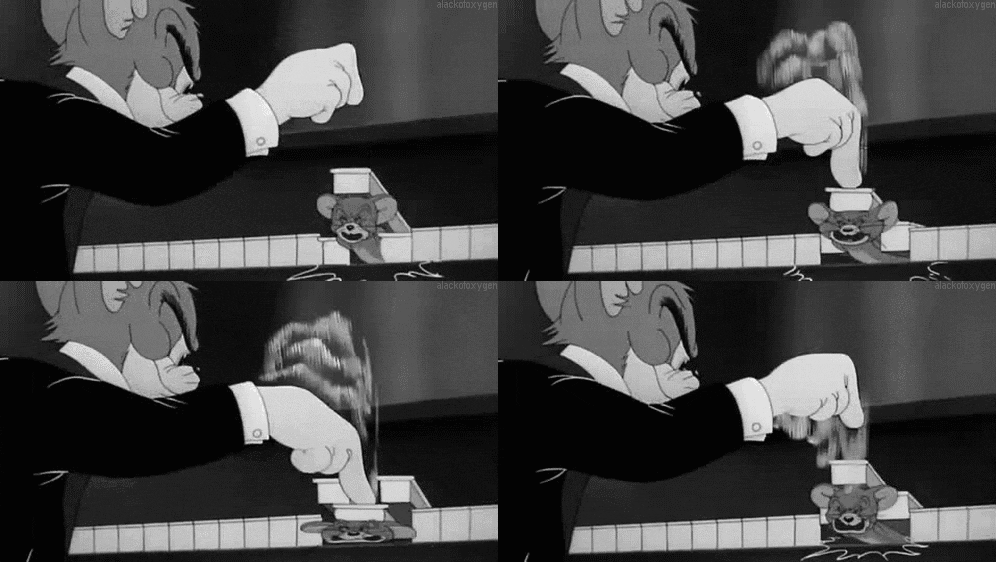
The cartoonish violence and excesses of Assisted Living may not be my typical fare, but the works of some of my favorite writers--Thomas Bernhard, Michel Houellebecq, and Angela Carter to name a few--can certainly be ugly other, possibly more damaging ways. After all, we're desensitized to violence pretty early on, whether through Tom & Jerry or Mortal Kombat, but the kind of bleakness in the work of these authors is altogether of a different, more corrosive variety. For instance, I've found that I need to allot myself several months between readings of Bernhard; otherwise I find myself on edge, depressive. I don't think this is an uncommon reaction to his work.
So why do I continue to read them? Because I prefer my humor black? Do I think that cruelty and violence are capable, in art, of shocking me into a more grounded awareness of the world? Or that works like this will rattle my complacency or awake me from my dogmatic slumber? A punch in the face does provide pretty indisputable evidence of being alive.
 This raises the question, of course: do we need an occasional jolt of ugliness (in the form of a bludgeoning book like Assisted Living) to keep our desire for endless beauty in check? Is ugliness necessary?
It's an ugly book.
Appearances aside, Assisted Living may represent a subtle critique of liberal democracy and the free market; it may expose the lurking dangers of fascism; it may be an outlandish commentary on the perennial battle of the generations; its excesses may even prove to be so cartoonish as to be a lampoon of such writing. I'm certain arguments can and will be made for all of these interpretations and more, but in the moment of reading, I find myself wondering: Why?
Not so much why write an ugly book, but why read it? To modern ears, it may sound naive to speak of the redemptive qualities of art, but I wonder if we've really moved beyond thinking that a book (or any piece of art) should serve a purpose, whether moral, instructional, or purely aesthetic. (And, despite its vileness, Assisted Living does have its literary qualities.) If we accept this as a valid question, what are we to make of books like this? Why do we read them? More personally, why do I read them?
I read ugly books.The cartoonish violence and excesses of Assisted Living may not be my typical fare, but the works of some of my favorite writers--Thomas Bernhard, Michel Houellebecq, and Angela Carter to name a few--can certainly be ugly other, possibly more damaging ways. After all, we're desensitized to violence pretty early on, whether through Tom & Jerry or Mortal Kombat, but the kind of bleakness in the work of these authors is altogether of a different, more corrosive variety. For instance, I've found that I need to allot myself several months between readings of Bernhard; otherwise I find myself on edge, depressive. I don't think this is an uncommon reaction to his work.
So why do I continue to read them? Because I prefer my humor black? Do I think that cruelty and violence are capable, in art, of shocking me into a more grounded awareness of the world? Or that works like this will rattle my complacency or awake me from my dogmatic slumber? A punch in the face does provide pretty indisputable evidence of being alive.
This raises the question, of course: do we need an occasional jolt of ugliness (in the form of a bludgeoning book like Assisted Living) to keep our desire for endless beauty in check? Is ugliness necessary?Thursday, January 19, 2012
Sunday, January 15, 2012
The Best Books We Read 2011...One Old, One New.
 In my last post The Best Books We Read 2011 I mentioned a lot of books that could have been my favorite of the year. I decided that two deserved special mention. The Land Breakers, a novel written by John Ehle in 1964 that remains- sadly- fairly unknown and Wunderkind the first novel by Nikolai Grozni, a Bulgarian-born, child-prodigy pianist who earned his MFA at Brown.
If you have never heard of John Ehle I am not surprised. Most of his books are out of print and though his wife and daughter are both well known actresses, he seems to have slipped into a literary underground. So, when a couple of us were at the NCIBA to talk to Michael Ondaatje about his latest novel The Cat's Table, when he asked us what we were reading (I mentioned Wunderkind) and I told him I had been reading a lot of Southern literature that he told the Random House people there that he's been wanting Random to put out John Ehle's books for years; mentioning specifically The Land Breakers. So I tracked down the small press, Press 53 out of Winston-Salem, NC and got a copy, read it, and was floored by this huge novel that focus on the settling of the Appalachian mountains. The characters, the tragedies, and the hardships are captivating and beautifully written with a knowledge of this area that is second to none. Ondaatje also mentioned the Harper Lee quote, who rarely did any blurbs or reviews, "Exciting... masterful storytelling." And she is not wrong.
 As for new, I read Wunderkind. I carried this book around for a couple of months before I actually delved into it. I loved the cover (I'm a sucker for a good cover) and had read the first few pages a few times and saw that it was going to be good. But I was reading Faulkner, and nothing short of Faulkner seemed to be what I wanted to read. Then one night I started Wunderkind. I did not stop from that point on. Reading Grozni's characters (specifically the protagonist, Konstantin the rebellious piano prodigy) and his insight into the world of private music school and classical music became obsessive reading for me. The were chapters that I reread before continuing on and then tracked down the classical pieces that were the titles of each chapter. This is a powerful and gripping novel that opened up my understanding of life behind the iron curtain, music and what it means to be music and not just love it.
These are two books I think everyone should read and most importantly tell others to read.
Wednesday, January 11, 2012
By the book
 There's a bibliomantic meme spreading around the internet (or at least Tumblr) that states the following: "Open the closest book to page 45. The first sentence will describe your sex life for the following year."
Naturally, I played along, opening The Wild Girl, Natural Man, and the Monster (thinking that with a title like that, there's got to be something good in store) to page 45, wherein I found the following sentence:
Once the girl is labeled an Eskimo (more precisely, a native of slightly less ferocious Labrador), her strangeness dissipates and her assimilation takes on greater value.Seems like 2012 is going to be... hot? Weird? Both? ("... her assimilation takes on greater value.") Maybe I need more exciting bedside reading.
But some of the people I informed of the meme seem to be on their way to much less ambiguity (and, possibly in the case of the next quoted sentence, more profit) in their sexual future. For instance, the first sentence on page 45 of that classic culinary standby, Joy of Cooking, supplies one reader with the following:
Informal opportunities for comparisons abound: Walk-around tastings are increasingly popular, often as fund-raisers.
Another, er, culinary delight, which I was told of by one of our sales reps this morning, comes from Simonetta Agnello Hornby's novel, The Nun:
"Ah, how I love swordfish," Annuzza murmured, licking her wrinkled lips, certain she could already taste it.
As I was typing this, I explained the meme to a Green Apple employee shelving nearby. Perhaps unluckily, he was holding a India Calling, which informs him rather literally that:
The dependency scares you, as a needy lover's demands scare you, for it suggests a bottomless pit of giving that will devour you if you give in just slightly and allow yourself to care.
And, finally, another friend happened to have David Burns Feeling Good at hand, and was told unequivocally,
You are lonely and you decide to go to a social affair for singles.I could do this forever. But now it's your turn.
Tuesday, January 10, 2012
Edmund White, an appreciation
by Green Appler Kevin Davis

This month I’m celebrating the publishing event of Sacred Monsters--a collection of Edmund White's “New York Review of Books” essays--and Jack Holmes and his Friend, a romance novel heavily informed by White’s pre- and post-Stonewall Manhattan life.
I have lived vicariously through this pioneer of gay sensibility in literature, who is also a generous, astringent critic with a monumental breadth of literary knowledge, entrenchment in high culture, and even friendships with late 20th century East Coast artistic luminaries.
White, who chairs Princeton’s Creative Writing Department, has lived a rarefied life by his pen in places like Rome, Key West, and the Ile Saint-Louis by cultivating wealthy patrons and grants.
In Monsters, White breathtakingly weaves criticism with biographical details that illustrate the wider story behind 20 artists and writers--Isherwood, Mapplethorpe, John Rechy, to name a few.
In his review of Paul Bowles’s The Sheltering Sky, a standout, White recalls the death of his lover in Morocco’s Atlas Mountain harrowingly wrought in his The Married Man.
Mr. White, who is 25 years my senior, first educated me at age 16 at San Diego’s Fashion Valley mall Waldenbooks on Christmas Eve, when I read his pointed instructions on the, to me, exotic gay men’s ritual of cruising.
He appeared again in timely fashion, to illuminate both our shared community and his own authentic, intricate emotional exploration when I read The Beautiful Room is Empty at age 27 in (former rare book dealer) Dr. Jack Collins's Queer Lit class at City College. The specific resonant events White illustrates from his young adulthood, are not so appropriate for this family medium though.
Today I still read White like those guys paint the Golden Gate Bridge. I read from one end of his memoir trilogy-- A Boys Own Story, Beautiful Room, and Farewell Symphony -- to the other, and back again. The consequences for me of foolishly opening a White title at bedtime is bleary sleep deprivation upon awakening. I am spellbound, entranced.
Today I still read White like those guys paint the Golden Gate Bridge. I read from one end of his memoir trilogy-- A Boys Own Story, Beautiful Room, and Farewell Symphony -- to the other, and back again. The consequences for me of foolishly opening a White title at bedtime is bleary sleep deprivation upon awakening. I am spellbound, entranced.
I’m not an open-minded, well-rounded reader, though. I tried Hunger by Knut Hamsun, a White progenitor who shares his exquisite cognitive honesty, only Hamsun operates in Nowheresville, Norway instead of Manhattan’s Chelsea Neighborhood, or Venice, and has no leather bars or casual sex to speak of.
I believe if one is lucky enough in life to discover one sympathetic artist applying his talent to elevate the customs and relationships of one’s tribe, well, that’s all I need.
Mr. White played a role in a mortifying event from my halting arts reporting “career.” I was given an open-ended 20 minutes of phone time in connection with a review I wrote of White’s 2006 memoir, My Lives. I crafted sweeping, informed questions, to convey my respect, and then out of nowhere, he turned the tables and asked, “Do you write?”
Flustered, I guffawed merrily. No, I don’t write in the sense that this Guggenheim fellow, and French Officier de L’Ordre des Arts et des Lettres, writes. But, tragically, I responded with one of those tactless, horrifying non sequiturs I’ve been guilty of many times which I now recall like a grisly slow-motion accident. I responded blithely, “Gosh your voice is so effeminate,” and laughed again.
Well, it really was high pitched, not the timbre I expected from one of the Great Men of Letters.
The newly created Magnus Books published Sacred Monsters under the aegis of esteemed longtime editor Don Weise, formerly of Carroll and Graf. Weise, who chose all the collection’s essays, was recently one of “Out” Magazine’s 100 most powerful gay people.
Mr. White played a role in a mortifying event from my halting arts reporting “career.” I was given an open-ended 20 minutes of phone time in connection with a review I wrote of White’s 2006 memoir, My Lives. I crafted sweeping, informed questions, to convey my respect, and then out of nowhere, he turned the tables and asked, “Do you write?”
Flustered, I guffawed merrily. No, I don’t write in the sense that this Guggenheim fellow, and French Officier de L’Ordre des Arts et des Lettres, writes. But, tragically, I responded with one of those tactless, horrifying non sequiturs I’ve been guilty of many times which I now recall like a grisly slow-motion accident. I responded blithely, “Gosh your voice is so effeminate,” and laughed again.
Well, it really was high pitched, not the timbre I expected from one of the Great Men of Letters.
The newly created Magnus Books published Sacred Monsters under the aegis of esteemed longtime editor Don Weise, formerly of Carroll and Graf. Weise, who chose all the collection’s essays, was recently one of “Out” Magazine’s 100 most powerful gay people.
Monday, January 9, 2012
Book of the Month: The Orphan Master's Son
It doesn't arrive until tomorrow, but The Orphan Master's Son by Adam Johnson is Green Apple's Book of the Month for January 2012. Why, you may ask?
Or here's Kevin Ryan's shelf talker:
Adam Johnson has said (I’m paraphrasing) that not every writer has a story to tell, and that not every person with a story to tell has the skill to write it, so writers must tell their stories for them. In The Orphan Master’s Son, Johnson tells the story of Pak Jun Do, raised in a North Korean orphanage. Citizens in the DPRK not only don’t enjoy freedom of the press and freedom of assembly, they truly don’t have access to freedom of thought, closed off as they are from the outside world and force fed a steady diet of propaganda. This brilliant, thoroughly-researched novel imagines life in that country, from citizens forced to “volunteer” to carry goats to the roof of their apartment building to be raised for food, to the horrors of the gulag, where dying prisoners are drained of their blood. But far from being a mere documentary of life in the DPRK, this is a hugely entertaining, often hilarious novel of assumed identity, casual cruelty, and collective delusion. Includes perhaps the greatest love scene ever to be written in jingoistic propaganda (“At length, in depth, their spirited exchange culminated in a mutual exclaim of Party understanding.”).
It arrives Tuesday, January 10, and you can buy it here or in the store. And here's the eBook version, if that's how you roll.
Subscribe to:
Posts (Atom)


 Posts
Posts