Saturday, June 25, 2011

The Store Mural

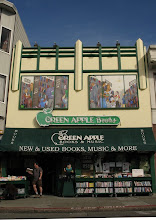
Here is a photo I found of the front of the store before we put the murals up on the facade. There are bookcases blocking the windows on the second floor, and someone had put tatami mats on the backs of the bookcases to make them more presentable, I suppose. What happened is that the mats got sun-damaged over time and, as you can see, the store began to look a bit derelict.

The murals, done by Back to the Drawing Board, a company that has done pretty much any of the interesting storefront art you've seen around town, are supposed to be windows, giving passersby a look "into" the store. Inside, browsing the stacks, we see Mother Goose, a space alien scanning a copy of To Serve Man, and Dashiell Hammett looking like he's about to shoplift one of his own books.

One interesting back story to the mural: when the artist did the first draft, it looked pretty much like it does now, except the customers were much better dressed. More business casual than Clement Street. No offense to our beloved patrons, but the people in that first draft just didn't look like most of the customers we see in the store on a daily basis. So we had the artist replace some pantsuits with sweatshirts, and the mural was born.


Friday, June 24, 2011

A Gallery of Rogues (abbreviated for palatability)

The critical reaction to V.S. Naipaul's misogyny (including Molly's justifiably indignant response on our blog) got me thinking about the uncomfortable fact that a number of my favorite writers--whether past or current--were, to phrase it none too delicately, dicks.

I know it would be more generous and fair to give each of the following writers his or her due by examining the historical, biographical, and sociocultural factors that contributed to the dickish behavior on display, but hey! we're on the internet. If you can't spew hate-filled vitriol without regard to the complexities of human nature on the internet, where can you? (Unless you're lucky enough to get a book deal.)

All joking aside, the ethical question of whether it's right to read a writer or admire an artist who exhibits such antisocial behavior as those below is a thorny one. Just where do aesthetics leave off and ethics begin? Does our admiration of The Artist excuse us from passing judgement on his or her life? And where does biography leave off and an artistic legacy begin?

Or should we agree with that wit Oscar Wilde, who once claimed that "There is no such thing as a moral or an immoral book. Books are well written, or badly written. That is all."

Or, on the other hand, with Georges Bataille, who argued contra Sartre, that "Literature is not innocent. It is guilty and should admit itself so."

Or...

Exhibit #1: Knut Hamsun

Hamsun looks dapper here, in 1925, with his wife Marie and the family dog, but twenty years later he'd be put on trial in Norway for his allegiance to the Third Reich. It wasn't bad enough that he gave his Nobel Prize medal to Goebbels; no, Hamsun actually went so far as to eulogize Hitler.

Exhibit #2: Patricia Highsmith

According to playwright/biographer Joan Schenkar, the acerbic, virulently racist, anti-Semitic, and malevolent Ms. Highsmith once threatened to leave her fortune to the Infitada.

Exhibit #3: Louis-Ferdinand Celine

Celine's hatred crackles not only through the pages of his work, but of his life as well. Jim Knipfel sums it up most succinctly by writing that Celine, anti-Semite and collaborator with the Vichy government, "was [to put it mildly] not a very pleasant fellow."

See also:

Maurice Barres, Ernst Junger, Gabriel D'Annunzio, August Strindberg, Yukio Mishima, Ezra Pound, Ayn Rand, Francois Villon, D.H. Lawrence, Anne Perry, &c. &c. &c.

Wednesday, June 22, 2011

Lacking

No Longer Human, Osamu Dazai's final (complete) novel could more literally be translated as "disqualified from being a human," but I suppose someone along the path to its Western publication decided that wording would not have the proper je ne sais quoi when faced out on the bookshelves. A shame, I think. Whereas "No Longer Human" seems to presuppose a world of curious advent, possibly even some kind of sci-fi connotation (nothing wrong with that), the less judicious version seems to get straight to the point. This is a novel about a weird sap that can't hang out with normal people. He's all twisted up. Lacking. Backwards. Completely without qualifications. It's a really neat book and you should probably read it before you die.

On a related note, Dazai committed suicide in the June of 1948.

Tuesday, June 21, 2011

ladies and gentlemen...Mr. Jesse Ball

Jesse Ball (1978-)


I have been telling everyone I have met since reading Jesse Ball's Samedi the Deafness that he is my favorite American author alive. I know this is a bold statement but I was blown away by the absurd being so effortless and natural. You encounter the story and world that Ball creates without being told that things are not what they seem and that they will change in impossible ways but that you will have no problem accepting them.

The same was true for The Way Through Doors. I couldn't put it down. Then a coworker gave me a used copy of Vera & Linus, written and published by Ball and his wife Thordis Bjornsdottir. I contacted Jesse and made this my staff favorite. It was my favorite of all his books. It is dark and troublesome and wonderfully disturbing (it isn't available through our web site so call the store, we will get you a copy).

Then last week a wonderful thing happened...
The Curfew was released. I have already read this book twice and may read it again soon. It is truly magical. It is truly sad. I want to tell you all about it but this about Jesse Ball is the minute you start you want to tell the whole story like a folktale. You want to pass on the story to as many people as possible. It's just the way his stories reveal themselves to the reader.


So I will tell you only how it starts so that you will want to carry on:


We are born in this cemetery, but must not despair.
-Piet Soron, 1847


PART 1


There was a great deal of shouting and then a shot. The window was wide open, for the weather was often quite fine and delicate during late summers in the city of C. Yes, the window was wide open and so the noise of the shot was loud, as though one of the two people in the room had decided to shoot a gun into the body of the other.

This was not the case, however. And because no one in the room itself had been shot, the man, William Drysdale, twenty-nine, once-violinist, epitaphorist, and his daughter Molly, eight, schoolchild, slept on.

Those were the methods of employment. Daily, Drysdale went about to appointments while Molly went to school and was told repeatedly to repeat things. She could not, and didn't.

Sunday, June 19, 2011

Maybe How to Live


(Where we will begin.)


I recently had an experience that, if being completely honest, most booksellers would call at the very least wince-inducing: the request for a book recommendation to serve as a gift, and a gift-giver who seems to know absolutely nothing of the recipient except for their age. "I'm looking for a book for a guy who's turning 34", for example. And there the information well seems to run dry. It's like when you would go to company barbeques with your parents and someone would say "Oh, the Whatzitfaces have a son your age, you'll have someone to play with." Except you're a girl and you're 9 and boy children are gross bizarre aliens to you and it turns out that Junior is actually 7 which is a GIANT difference and you both have to sit in the backyard and guess at everything to find anything at all in common with this other life form. Didn't you hate that? These moments can be sort of like that.

The nice thing is that sometimes they can take a turn for the thoughtful. This customer (shopping for a recent high school grad) did have some vague parameters for the book she was looking for, and they were as follows: "Nice", "something that will teach {the reader} something, maybe how to live", "with some pretty pictures or something", and "not a stupid book" (the latter was repeated many times).

She did not say: inspirational, motivational, uplifting.

She did (essentially) say: smart.

I liked that.

Sometimes I think that, particularly in this season of graduations, transitions, and new beginnings, it's easy to default to words like "inspirational", when what we are really looking for out of the world is "intelligent with joy". One is prescriptive, the other descriptive -- one kind of book tells you how to be, the other shows ways that people are and, perhaps most illuminating and comforting, how people have been before you. Of course, books intended to motivate and inspire can serve a wonderful purpose, and sometimes that sort of finger-wagging "just do it, damnit" tone is exactly what one needs to do some bootstrap lifting when life inevitably is very hard. But in general, I am of the opinion that a book that makes your world bigger is better for you than a book that makes it smaller and more about you.

And this is how my vague and tight-lipped gift-giving customer and her could-be-anyone invisible gift-givee have ended up with a copy of Maira Kalman's The Principles of Uncertainty. I recommended this with complete confidence in its ability to meet her parameters.

It's nice:


It has pretty pictures:


It will teach the reader something (maybe how to live):


And it's not stupid. It's smart:


But not, you know, too smart:


And (last but not not least appealing) about we've got it in hardcover for a mere $12.98 (not listed on our website, as it is a remainder, but we've got plenty of copies. Just give us a call).

Intelligent with joy. Off you go, could-be-anyone. This is good for you.

Friday, June 17, 2011

Everything is coming up roses (a rose is a rose)

Alice B. Toklas and Gertrude Stein at home (by Man Ray)

In Everybody's Autobiography, Gertrude Stein famously summed up a visit to Oakland, the city where she spent her formative years, by writing that "Whenever you get there, there is no there there." Stein's oft-misinterpreted and typically gnomic line refers to the disappearance of her childhood home as much perhaps as a particular sense of cultural dislocation that a long-time resident of Paris must have experienced upon visiting California in the 1930s. Stein, of course, was not just any Parisian, but one who, along with first her brother Leo and later her partner Alice B. Toklas, famously surrounded herself with artists now recognized as the revolutionaries of modern art, including Picasso, Cezanne, and Matisse.

Were it possible for the ever-confident, self-assured, and endlessly and eagerly photographed Stein to return to California now, seventy years after her trip through Oakland, she may find herself inclined to revise her opinion of our lack of thereness, if only due to the happy accident that has San Francisco (Toklas' home town) on the verge of Steinian delirium. Between the Contemporary Jewish Museum's contextualizing Seeing Gertrude Stein: Five Stories and the SF MOMA's The Steins Collect exhibits, it seems we're in for a summer of breathlessly unpunctuated excitement.

Or maybe this feverish excitement is limited to Green Apple, surrounded as we are by what seems like a blessed deluge of books about, relating to, or touching upon our most famous literary emigrant. Although not all of the following books are tied to the concurrent exhibits, the serendipitous coincidence (not to mention seeing Stein's mug plastered all over town) has me eyeing my copy of The Making of Americans with a sense of guilt. (Although I could cop out--if listening to a 913 page book could be considered a cop out--and sit back while Gregory Laynor's performs the book for me.) (Do yourself a favor and listen to page 906.)

If any of this has made you feel the urge to brush up on Little Gertie*, take a look at the books below: from Atak's beautiful (and difficult to keep in stock) interpretation of Stein's story "Ada" to the hefty companion to The Steins Collect, I'm sure you'll find something in which to dip your toe before moving on to sentences like
Once upon a time there was no dog if there had been a dog nobody wept.

Once upon a time there was no name and if any one had a name nobody could cover a name with a name. But nobody wept except somebody who had not that name wept.

Atak's illustrated version of Stein's Ada, her first "word portrait" and a significant artistic breakthrough, is a bright and bold interpretation well-suited to the subject. Since I'm entirely ignorant of printing techniques, I'll quote from the book's publisher:
Atak’s unique style of illustration harks back to the days of chromolithography. As with these early printing techniques, on every page of the book each print layer is meticulously created by hand directly onto film. There are only a handful of artists left still using this technique and the result is inimitable. The book has the look and feel of something created in the early days of printmaking.

The Steins Collect is the companion book to the MOMA show. Read more about it on the Yale Press Log, which also informs us that the Press will be reviving two more of Gertrude Stein's work this fall, perhaps turning this summer of Stein into a veritable revival.

Steins' The World is Round is out-of-print (although you can view the edition illustrated by Clement Hurd--he of Goodnight Moon fame--on Flickr), but To Do, a follow-up to that book is a nice consolation, as consolations go. Molly explains why we're so infatuated with this one:
This whimsical book begins with the reassuring fact that everyone has a name and a birthday, taking a dizzying journey through the alphabet and the names therein. Never published in Stein's lifetime because it was deemed too obscure for children and adults, Yale University Press thankfully saw it as perfectly suited for both.

In 1906, Harriet Lane Levy was convinced to move to Paris from San Francisco by her friend Alice B. Toklas. Finding herself suddenly immersed in "in a strange world peopled by artists who spoke a language she could not understand--a colorful world that she could only remotely observe in black and white," Levy compiled these brief reminiscences which were until recently tucked away at the Bancroft Library. A fine book capturing an exciting era.

And, of course, there are the books by Stein herself, if you're so inclined.


__

* "Little Gertie is a little schnatterer. She talks all day long and so plainly. She outdoes them all. She's such a round little pudding, toddles around the whole day and repeats everything that's said or done." -- from a letter written by Stein's father, quoted in William Gass' essay on "Gertrude Stein and the Geography of the Sentence" (in The World Within the Word)

Wednesday, June 15, 2011

The Inner Richmond

My originally casual interest in photography somehow mutated into an expensive compulsion over the last few years. For the better part of this time I have been employed at Green Apple Books & Music. When I find myself excited to see how some photographs are going to turn out but still have some shots left on the roll, it is not uncommon for me to bring my camera to work and try to finish it off, wandering around Clement and the avenues on breaks. Fortunately this neighborhood is a massive pile up of personality and culture condensed into a tiny space, so I am never lacking of subtly odd or amusing sights. As if there was any more need for reasons to stop by for a visit.

Chinese New Year Celebrations
These women were all trying to build 'perfect dozens' at the grocery store, which I think is totally crazy and I love it.
How do they make dogs like this?
This last picture was was taken by my coworker, billed as 'A' on this blog. I was lacking my camera that day, but we agreed that the little tub was just begging to have his photo taken.
