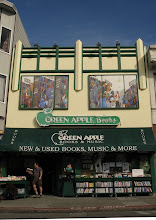
Thursday, August 9, 2012

San Francisco Punk -- Then and Now, Mostly Then

Reissues outsell new records. That's why shops, mailorders, and labels continually invest in them. People would rather buy something they know is good than something they have to try out. Also, every year there are new folks who are getting excited about these artists for the first time. This summer, reissued works of San Francisco punk from the '70s, '80s, and '90s have brought some long-awaited material back to the public. In this reporter's opinion, there is some seriously good shit to be had.

     In the fall of 1976, a teenaged Penelope Houston left Seattle to enroll at the SF Art Institute, up on the hill in North Beach. By 1977 she was fronting the Avengers, and her shorn blonde hair and leather jacket graced the covers of their records. By the time the band split in 1979, they'd recorded quite a bit of material, but only a single and a 12" EP had appeared. In 1983 the local label CD Presents released a self-titled Avengers LP, with almost all of their recordings. By the time I'd heard of the band, all of this material was out of print. As the years went on a few singles and live recordings appeared. It's only now, at long last,  that the LP has been reissued. Four Men With Beards is doing the vinyl, while Water Records is doing a double-CD version, with live recordings, outtakes, and a comp track--one of their greatest songs, 'Cheap Tragedies,' which appeared on the legendary, long out of print Rat Music For Rat People LP.


       In the winter of 1978, the British group the Sex Pistols played their final shows on an ill-fated American tour, finishing their careers (as did the Beatles) here in San Francisco. A twenty-something Texan, Gary Floyd, was at the show, and he retunred to Austin eager to contribute to the emerging punk scene there. It took too long to form a band, so he flyered the city with posters for non-existent shows featuring his non-existent band, the Dicks. But before long, the band was real. 1980 saw their first single, Dicks Hate the Police, an instant classic reflecting the, uh, tension between good-ol'-boy cops and Texas queers and freaks. In 1982 their first LP, Kill From the Heart, was released on Los Angeles's SST Records. At this time the band relocated to San Francisco, but after a particularly difficult tour the other guys headed back to Texas, leaving Gary to reform the band. This new line-up released the Peace? 7" in '84 and the These People LP in '85. All of this material went out of print, with Kill From the Heart and Dicks Hate the Police commanidng high prices on the collector's market and being repeatedly bootlegged. I'd never heard either LP until Alternative Tentacles reissued both this summer. The CDs contain the 7"s, and 1-2-3-4 Go! also reissued Dicks Hate the Police on vinyl. Kill From the Heart blew my [freakin'] mind--thrashy, bluesy, 90-second (give or take) songs guaranteed to inspire disgust in decent, patriotic people (racist police will be particularly offended.) Now I can see how the greatest punk history website in English was inspired to borrow this LP's title for its name. These People continues the attack, specifically targeting militarism this time, but with less thrash and more rockin' blues. Gary was and remains an incredible performer, so don't miss out when his solo projects perform.


     South Florida, early 1990s--four young men form a band whose name is an obscenity, causing them to sometimes play out under the abbreviated moniker F-Boyz. After a few 7" releases, the band relocated to San Francisco's Mission district. When the singer moved back home, the guitar player, Matty, took over on vocals, and they recorded their final 7",  vs. the Hawaiian Mafia, the title inspired, in what would become a recurring theme, by death threats left on their answering machine. When the bass player left as well, Matty and the drummer, Aesop, recruited a new bassist and formed a new band, Hickey. In the band's first three years they had three 7" EPs, two split 7s", and numerous compilation tracks. In '97 local label Poverty Records compiled all of this, along with unreleased material, as the CD Various States of Disrepair. After Poverty went belly-up, an East Bay concern, S.P.A.M. Records, reissued this disc, and soon they were gone as well. In early 1999 the band went "on hiatus," and while Aesop and Matty played out together and with others in a great many bands, Hickey never performed again. Hickey remained beloved owing to their inspiring songs, relentless touring, and amazing stage presence. Matty died in 2002, and Hickey's music (as well as other work of his) was posted free on a tribute website. A live DVD and a reissue of Various States were oft-rumored, but elusive. Finally, this summer saw Oakland's 1-2-3-4 Go! Records release a remastered CD and double LP reissue, with nine new songs recorded after the first disc had come out. I snatched up a double LP upon its arrival here at our Fiction & Music Annex, and it has yet to leave my turntable. These tracks highlight the range of styles the band had mastered, with catchy, melodic, sing-along numbers; epic, four-minute big-guitar meetings of punk and 70s rock; lazy, ugly dirges; compressed, savage, grating attacks; mellow indie rock... I can't stop singing these songs everywhere I go. Seeing the Hickey heart (their logo) spray-painted or etched in cement (like at Duboce at Church by the outbound train stop and the sidewalk at 9th and Irving) always makes me smile.


     To be fair, though, the greatest punk music is being made now, or at least that's the attitude you gotta have to avoid being a washed-up adult. All of the bands discussed above were very popular in small scenes, but largely unknown to the general public, and so it is with today's most inspiring bands. The easiest way to get a weekly dose of new and old obscurities is to visit a website hosting a weekly radio show recorded in a live/work space here in San Francisco. Maximum Rocknroll is a volunteer-run monthly magazine, thirty years old this month! Ever since day one these kids (in the political sense) have been digging in to the best music they can find from around the world. The radio show started in 1977, preceding the magazine by five years. The over-the-airwaves show died when the guy who dubbed all the tapes in real time to mail to radio stations finally burnt out. With the advent of internet radio, the show was reborn and remains strong as [heck.] The magazine is hella sweet too. Check it out in our Annex.      .   

Saturday, August 4, 2012

A coupla apples

It's been a while since we last updated our loyal readers (there are a few of you, right?) on the further adventures of our subscription plan, The Apple-a-Month Club. Although the last two installments have gone unreported, I can assure you that the program continues on, with your intrepid professionals scouring the latest and best fiction (and just to be complete, some of the not-best fiction, too) to dig up a book sure to delight, provoke, or otherwise entertain our subscribers.

If our reaction to the last two Apple-a-Month books is any indication, we think that our 8th and 9th books in the subscription plan are two of the strongest titles yet. Without any further ado, then, here's what we have to say about June's selection, Crusoe's Daughter:

"It's been a long time since I've been as surprised and utterly charmed by a novel as I was by Crusoe's Daughter. At once a masterfully written portrait of early twentieth century England and a fun story full of endlessly complex characters, Crusoe's Daughter begins with young orphan Polly Flint arriving at a strange yellow house on the moors which is inhabited by an even stranger pair of aunts. Through two World Wars, a bizarre stint at a mysterious home for artists on the verge of nervous breakdown, the lives and deaths of many of her loved ones and her own rather drastic ups and downs, Polly keeps close her beloved copy of Robinson Crusoe, which she considers her guidebook to all things. With nods Dickens and Charlotte Bronte (and the constant presence of Defoe) but with a wit and voice of her own, Jane Gardham weaves a remarkable tale of a life -- inner, outer, and all the intersections therein."

In July, we chose a novel translated from the French, Marie Chaix's Laurels of Lake Constance (trans. by Harry Mathews):

"History, we all know, is written by winners. Marie Chaix's  novel shows the flip-side of that well-worn axiom, offering a poignant account of a man (a fictionalized version of her father) who made a disastrously wrong choice and, as a consequence, ended up on the side of the losers. It's a novel about war, politics, and family. Even more, it's about distance: the distance between heartfelt conviction and the practical application of those convictions; the distance between members of a family; and perhaps most achingly, the insurmountable distances borne of war."

If either of these (or any of our previous selections) intrigue you enough to join our club for 3, 6, or 12 months, visit our subscription page or call us at the store (415-387-2272) or, hey, come on by! We like visitors.

Tuesday, July 24, 2012

Misshelved True Crime


While one might think the content of a non-fiction work indicates where in the store it will be shelved, this isn't always true. Today we will examine three books, all of which by content are clearly True Crime, but might be shelved elsewhere at the behest of the publisher's marketing department.    

     The first and most horrific title is A Stolen Life: A Memoir by Jaycee Dugard. The author was abducted at age eleven and lived the next eighteen years in a backyard shed in Antioch, CA. Her captor was a sex offender and the book does not spare much detail as to the circumstances she faced. I haven't read it, and maybe never will, as these particular gruesome details are too much for me. This title is marketed as a memoir, and I do trust the people at Simon & Schuster to know how from whence their stock will best sell. John Glatt's book on the case, Lost and Found, is shelved in True Crime, and there's no reason for Dugard's account to be anywhere else, except the belief that folks who do not browse True Crime will buy it.

      Just recently published and expertly done is Killer On The Road by Ginger Strand, published by the University of Texas Press. The back cover identifies the subject matter as "History," which is true in a sense but also disingenuous. The author looks at the effect the national highway system has had on murder in America. Most people today have lived with highways all their lives, so do not appreciate what an incredible change this public works project had on the country. She looks at particular cases in depth, and has no shortage of material to draw from. From my perspective, the greatest chapter concerns the Atlanta child killings of the early 1980s. The stated goal of building the freeway system through the heart of the city was to provide rapid access from the suburbs to the downtown core. As it happened, many thousands of residential housing units were destroyed, almost all of which had been occupied by black people. The black neighborhoods remaining in the shadows of the on-ramps were physically and economically divided from each other and the rest of the city. The result was neighborhoods which had not been poor became so, and those that were poor became desperately so. As readers of True Crime have noted again and again, the poorer the missing person, the less the police investigate. Students of the genre will be excited here, as for this chapter, Strand relies heavily on an out-of-print & scarce title, The List by Chet Dettlinger. He was an detective with the Atlanta police, one of many assigned to the case, and became rather critical of how the investigation was handled. When Wayne Williams went on trial for two of these killings, Dettlinger worked with the defense. Strand meshes the disregard for downtown Atlanta blacks by federal and local governments with the inability of all involved to stop these children from being killed. Once Williams was convicted of the two counts of murder, almost all of the twenty-plus remaining unsolved cases were closed. The final chapter of Killer On The Road examines the physically and psychologically punishing job of cross-country trucking, and the extent to which this profession attracts and/or creates killers. This book is highly recommended.

     Our final tome today is 2009's Police Interrogation and American Justice by USF professor Richard Leo. We shelve this title in Legal Studies, and have been able to sell roughly one a year since it came out. I'm not sure how much longer it will remain in print, but this book is important to an understanding of how the criminal justice system works in practice. Leo sat in on hundreds of hours of interrogations in East Bay police departments, and his research does not instill confidence in their methods. The list of True Crime books wherein a false confession enables the actual perpetrator to continue to victimize others would be long indeed. I: The Creation of a Serial Killer by Jack Olsen, Central Park Five by Sarah Burns, and The Devil's Knot by Mara Leveritt are three we carry new. This nearly happened in Bringing Adam Home by Lee Standiford. Edward Humes's out-of-print Mean Justice describes the production of false confessions as being considered quality police work in the eyes of exceptionally dangerous Kern County cops and prosecutors. Of course, coercing someone into an undeserved prison term is a hell of a crime in itself. Society is doubly victimized as the actual criminal remains free. Police and prosecutors have proven extremely reluctant to re-evaluate their techniques, even in the face of overwhelming evidence of their failures.

     Crime and anti-social deviance permeate our society. For sure Business, Environmental Studies, Political Science, Sociology, and any History section will have books just as fearsome as those to be found in True Crime.


Tuesday, July 17, 2012

Psssst...


Speak softly, but spread the word: the original venue for Litquake's annual bash has been changed at the last minute due to the club's violation of liquor laws. . .

Ironic that the name of this year's Litquake party is Password: A Literary Speakeasy, and will feature in-character readings from the likes of Dashiell Hammett (Eddie Muller), Dorothy Parker (Sarah Fran Wisby), and many others. Awesome that the shindig will be hosted by the lovely (but not so silent) screen-star, Louise Brooks (Alia Volz), and will include Prohibition-era cocktails, as well as jazz, and a caricaturist. Dreamy in the fact that there will be a Thin Man movie marathon.

Best of all - tickets are still available - just tell 'em Mergatroid sent you!

Thursday, July 19th 8:00PM
(new location) Public Works 161 Erie Street map

Saturday, July 7, 2012

no "Q"uestion about it

when people ask me where my favorite place to eat is around here i tell them hands down, unequivocally, with no bias whatsoever, in complete confidence and honesty: Q restaurant.  conveniently located a few blocks away from us at 225 clement (between 3rd and 4th avenues), this delectable gem has great food (seriously, the meatloaf and tater tots are my favorite), amazing seasonal specials, a fantastic wine selection (you gotta try the "Sexy" from portugal, no joke), a fun and energetic staff (some of whom just so happen to be good friends of mine, and the more you go there, you just might consider them friends of yours as well), funky decor (the magnet alphabet letters are a riot), yummy desserts and the proverbial icing on the cake: frooties that come to your table when the check is presented.  if that is a metaphor to sweeten the process of paying the bill then i am 100% behind it.  if you have never had a frootie, you are seriously missing out on one of the best candies ever invented, and i will argue my point with authority as i am considered 'that guy who likes candy' around the bookstore.  and here is the kicker, my favorite flavor:

and making a rare appearance for special occasions
(i ate dinner there last night and my server tossed these my way, laughing as she did so,
and honestly, what's a better occasion than that?)


so go see my friends, enjoy some down-home fantastic food, some sexy wine, the excellent musical ambiance (that i forgot to mention earlier), and some frooties in the best place to eat in the neighborhood.

Tuesday, July 3, 2012

Sacco-philia


The Third World is a tough place to live. Privation, a poisonous environment, ignored (at best) by state forces, malnourished and short-lived in sub-standard housing--billions of people through the world live in such circumstances. While existing in the popular mind as a far-flung locale, the Third World is better conceptualized as the land and people of any country deemed useless by capitalists. Comic journalist Joe Sacco teamed up with muckraker Chris Hedges to document Third World conditions here in the the US. Days Of Destruction Days Of Revolt (Nation Books) examines desperate and destitute people in New Jersey, New York, West Virginia, Florida, and South Dakota. Sacco's intricate artwork and unblinking sympathy dovetail with Hedges's examinations of social forces leading to personal suffering.


     A collection of Sacco's earlier work also graces us this month. Journalism (Metropolitan Books) collects pieces previously published in outlets such as Time, Details, Harper's, Virginia Quarterly Review, and the Boston Globe, among others. He focuses on migrants and the displaced, those fleeing economic or military crises. His artwork is incredible, but it's his relationship to his own stories I admire most. He includes himself and his gathering of stories in the comics, illuminating his own subjectivity as an author. 

     Probably these titles will not make one feel better about the state of our world. But as edifying recent history they are highly recommended. For those who are discovering Mr Sacco for the first time, his earlier works on conflict in Bosnia and Palestine are also a wise investment.       

Friday, June 22, 2012

Reading Harvey Milk Live

Authors KM  Sohnlein and Alvin Orloff read from The Harvey Milk Interviews: In His Own Words edited by Vince Emery, on Tuesday June 19 at the Human Rights Campaign Store


They, along with Daniel Nicoletta, Larry Bob Roberts, Tommi Avicolli Mecca, Marke Bieschke and Kevin Killian made this an entertaining and educational event. This photo was purloined from Kevin Killian's Facebook page. We had free cookies donated by Hot Cookie and coffee from 18th Street Starbucks. And we raised a little money for the Lavender Youth Recreation and Information Center.