


Continuing our series of interviews with independent publishers, this week we have an interview with Martin Riker, associate director of Dalkey Archive Press. Like Open Letter Books, which was featured in our previous segment, Dalkey Archive is a non-profit publisher (affiliated with the University of Illinois) engaged in what founder John O'Brien calls a "quixotic venture" of publishing the best of contemporary and seminal world literature. As can be seen in the following interview, Dalkey Archive represents something of an anomaly in the publishing industry, being concerned less with sales than with making available engaging and challenging books.
We'd like to thank Martin for his time.

GA: Instead of a reductive mission statement, Dalkey Archive seems to take a broader view of publishing. John O’Brien, founder of the Press, adheres to a belief in literature's capacity to alter perceptions. Can you explain how this plays out practically? In other words, what is a "Dalkey Archive" book?
MR: It's a question of aesthetics, of what sorts of art we are most interested in. That might seem obvious, but it's the best place to start, since what that means is that we do not start from questions of marketability (sales potential) or "cultural relevance" (we don't publish translated books just because they're translated, for example), but simply ask ourselves, "is this a book we love?" Once the answer is "yes" and the decision is made to publish a book, then we immediately forget about aesthetics and art and focus on how best to sell the book, or how to get it to the widest audience in the most meaningful way. We're a nonprofit mission-based organization, but publishing books we think are important is only half of that mission; getting them read is the other.

We'd like to thank Martin for his time.

GA: Instead of a reductive mission statement, Dalkey Archive seems to take a broader view of publishing. John O’Brien, founder of the Press, adheres to a belief in literature's capacity to alter perceptions. Can you explain how this plays out practically? In other words, what is a "Dalkey Archive" book?
MR: It's a question of aesthetics, of what sorts of art we are most interested in. That might seem obvious, but it's the best place to start, since what that means is that we do not start from questions of marketability (sales potential) or "cultural relevance" (we don't publish translated books just because they're translated, for example), but simply ask ourselves, "is this a book we love?" Once the answer is "yes" and the decision is made to publish a book, then we immediately forget about aesthetics and art and focus on how best to sell the book, or how to get it to the widest audience in the most meaningful way. We're a nonprofit mission-based organization, but publishing books we think are important is only half of that mission; getting them read is the other.

GA: As a follow-up to the first questions: the Submissions Guidelines on the website states that Dalkey is looking for works of fiction belonging to the tradition of Sterne, Joyce, Rabelais, Flann O'Brien, Beckett, Gertrude Stein and Djuna Barnes. Do you see a unifying approach or theme in the work of these writers?
MR: I sort of didn't answer your first question because I thought I'd answer it here with your second. I could write a dissertation on this question (actually, I did write my dissertation on this question, or something quite like it) but the short answer that I like to give is that these are writers who take the long view of literature. People will talk about Dalkey Archive books as "experimental"---our publisher uses the term "subversive"---but in my mind it is fundamentally a question of perceiving literary art as a thing that is both of its time and part of a conversation that spans over many eras. A writer who views literature this way is not likely to be interested in what's currently popular, and therefore doesn't really care whether he/she is "avant-garde"; at the same time, such a writer is not going to see him/herself as being in conversation strictly with the dominant stylistic modes of the time. Many of the writers who look "experimental" to us today only look that way because the writers they are responding to (or stealing from) are not their immediate predecessors. Another way of saying that is that everything looks "experimental" to people who haven't read very many books. If all you've read are romance novels, the Yellow Pages will look experimental. Taking the long view of literature, on the other hand, means being interested in literature as an art form, with its own history and with various traditions that can be played with, reinvented, and subverted in order to make a compelling word-filled object that carries some real liveliness. Once you make the shift to caring about art, the innovation and experimentation is just standard.

GA: Besides the publishing books, Dalkey is also involved in producing the Review of Contemporary Fiction and Context. Can you give a brief description of these publications and their aims?
MR: Our origins are in literary criticism, in talking about books and in seeing critical discussion as a relevant part of the (literary) artistic experience. The Review was our first publication (in 1981) and is still publishing three issues per year today. We just published an updated version of our Georges Perec issue, which happens to be my favorite. Context is a free newsprint and web magazine that we started in 2000 as a way of reaching younger readers. Over the years we've had some incredible contributors and published some extraordinary pieces, which are all available free on our website.
GA: A question made especially pertinent now: How does a non-profit publisher survive in tough economic times?
MR: It would be nice to be able to answer that nonprofit publishers are immune to the economy because we can turn to grants and donations for support, but the truth is that the philanthropic community has been hurt as badly as anyone. We're fortunate to have the support of the University of Illinois, where our main office is located, and a broad range of funders in both the US and Europe. And of course we sell books. Having a lot of different sources of income, rather than relying on one source, is no doubt an advantage.
GA: What's up next for Dalkey Archive?
MR: We've joined up with Norton, who will be distributing our books as of Fall. We're launching an annual anthology of European fiction (Best European Fiction 2010) starting in January. Aleksandar Hemon is the series editor, and Zadie Smith's agreed to write a preface. We're publishing about 50 titles this year---more than in past years---including a lot of my favorite writers (Jean-Philippe Toussaint, Gert Jonke) as well as writers new to our list (Andrej Stasiuk, Goncalo Tavares). Our London office is about to become one of the originating members of a exciting project called the Free Word Centre, which will be officially opening in September, and will serve as an international center for advocacy on behalf of free speech (PEN is another member), literature, and culture. We're working with the Center for Translation Studies here at the University of Illinois; they've put together a number of translation studies programs that involve students with working at Dalkey Archive . . . I could go on. There's a lot.
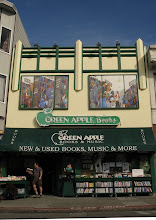
GA: Finally, if you were given the opportunity to choose a book for Green Apple's "Staff Picks" display, what would you choose?
MR: Only one? Probably Jacques Roubaud's The Loop, which I think is one of the greatest books we've ever published---although there are a lot of great books on the current (spring) list. Maybe also Ignacio de Loyola Brandao's Anonymous Celebrity, which is at the printers right now. A sort of Swiftean send up of the international cult of celebrity, by one of my favorite Brazilian writers. That comes out in August.

MR: I sort of didn't answer your first question because I thought I'd answer it here with your second. I could write a dissertation on this question (actually, I did write my dissertation on this question, or something quite like it) but the short answer that I like to give is that these are writers who take the long view of literature. People will talk about Dalkey Archive books as "experimental"---our publisher uses the term "subversive"---but in my mind it is fundamentally a question of perceiving literary art as a thing that is both of its time and part of a conversation that spans over many eras. A writer who views literature this way is not likely to be interested in what's currently popular, and therefore doesn't really care whether he/she is "avant-garde"; at the same time, such a writer is not going to see him/herself as being in conversation strictly with the dominant stylistic modes of the time. Many of the writers who look "experimental" to us today only look that way because the writers they are responding to (or stealing from) are not their immediate predecessors. Another way of saying that is that everything looks "experimental" to people who haven't read very many books. If all you've read are romance novels, the Yellow Pages will look experimental. Taking the long view of literature, on the other hand, means being interested in literature as an art form, with its own history and with various traditions that can be played with, reinvented, and subverted in order to make a compelling word-filled object that carries some real liveliness. Once you make the shift to caring about art, the innovation and experimentation is just standard.

GA: Besides the publishing books, Dalkey is also involved in producing the Review of Contemporary Fiction and Context. Can you give a brief description of these publications and their aims?
MR: Our origins are in literary criticism, in talking about books and in seeing critical discussion as a relevant part of the (literary) artistic experience. The Review was our first publication (in 1981) and is still publishing three issues per year today. We just published an updated version of our Georges Perec issue, which happens to be my favorite. Context is a free newsprint and web magazine that we started in 2000 as a way of reaching younger readers. Over the years we've had some incredible contributors and published some extraordinary pieces, which are all available free on our website.
GA: A question made especially pertinent now: How does a non-profit publisher survive in tough economic times?
MR: It would be nice to be able to answer that nonprofit publishers are immune to the economy because we can turn to grants and donations for support, but the truth is that the philanthropic community has been hurt as badly as anyone. We're fortunate to have the support of the University of Illinois, where our main office is located, and a broad range of funders in both the US and Europe. And of course we sell books. Having a lot of different sources of income, rather than relying on one source, is no doubt an advantage.
GA: What's up next for Dalkey Archive?
MR: We've joined up with Norton, who will be distributing our books as of Fall. We're launching an annual anthology of European fiction (Best European Fiction 2010) starting in January. Aleksandar Hemon is the series editor, and Zadie Smith's agreed to write a preface. We're publishing about 50 titles this year---more than in past years---including a lot of my favorite writers (Jean-Philippe Toussaint, Gert Jonke) as well as writers new to our list (Andrej Stasiuk, Goncalo Tavares). Our London office is about to become one of the originating members of a exciting project called the Free Word Centre, which will be officially opening in September, and will serve as an international center for advocacy on behalf of free speech (PEN is another member), literature, and culture. We're working with the Center for Translation Studies here at the University of Illinois; they've put together a number of translation studies programs that involve students with working at Dalkey Archive . . . I could go on. There's a lot.
GA: Finally, if you were given the opportunity to choose a book for Green Apple's "Staff Picks" display, what would you choose?
MR: Only one? Probably Jacques Roubaud's The Loop, which I think is one of the greatest books we've ever published---although there are a lot of great books on the current (spring) list. Maybe also Ignacio de Loyola Brandao's Anonymous Celebrity, which is at the printers right now. A sort of Swiftean send up of the international cult of celebrity, by one of my favorite Brazilian writers. That comes out in August.

(As a postscript: my favorite Dalkey Archive book is Stanley Crawford's criminally neglected masterpiece The Log of the S.S. the Mrs. Unguentine. It's safe to say this is a book unlike any other.)




 Posts
Posts

